
Idea
Best Video Content Strategies for Tech Startups in 2026
Every tech founder knows they need video.

Sergey
June 15, 2026
Every tech founder knows they need video. But when it comes time to allocate the marketing budget, a paralyzing question arises: "What kind of video do we actually need?"
Historically, about two-thirds of all tech innovations fail upon launch. This rarely happens because the technology is bad. It happens because of a cognitive and behavioral disconnect between what innovators build and what consumers are psychologically ready to accept.
If you want your product to survive, your marketing can’t just be a shiny list of features. It must be a tool for behavioral change. Through our specialized video production for startups at Lava Media, we help founders bypass consumer resistance and turn complex tech into undeniable value.
Below, we break down the best video content strategies for startups in 2026, blending product-led growth (PLG) frameworks, behavioral economics, and neuro-marketing. Here is your blueprint to drive mass adoption.
Humans are evolutionary wired to minimize risk. Consumers suffer from Status Quo Bias—they overvalue the comfort of their current habits by 3x. Meanwhile, founders overvalue their new product by 3x. This creates a massive "9x Disconnect."
To break through this psychological inertia, your product must offer a 10x improvement, and your video must visualize it using Loss-Aversion Framing. People hate losing twice as much as they love gaining.
The Video Strategy:
Stop making videos about what the user will gain. Make videos about what they are bleeding daily by sticking to the old way (money, hours, metabolic energy). Address their Sunk Cost Bias head-on by proving that doing nothing is actually the most expensive choice.
Real-World Application (Lava Media Case Study):
When Lava Media works with industrial tech or infrastructure startups—where the innovation is literally buried inside a machine or under a road—you can’t film it with a camera. We use high-end 3D Animation to visually strip away the layers, revealing the hidden inefficiencies and financial "leaks" of the old system, and then visually proving the 10x ROI of the new technology. You can see examples of this deep-tech visualization in our portfolio.
For SaaS startups, Product-Led Growth (PLG) is the standard in 2026. But new software carries a high internal cognitive load. Human working memory can only hold about 4 pieces of new information at once. If your onboarding video overwhelms the user, they will experience decision fatigue and churn.
In 2026, top PLG companies aim for a Time-to-Value (TTV) of under 60 seconds.
The Video Strategy:
You need a hyper-focused 2D Motion Graphics or Isometric UI Explainer. Do not show every button in your dashboard. Use visual narratives to guide the user's eye to the "aha!" moment instantly. If you pair this video with a short, 7-day trial, you create the perfect mix of psychological urgency and low cognitive friction.
Real-World Application (Lava Media Case Study):
For complex B2B SaaS platforms, Lava Media designs custom 2D animations. Instead of boring screen recordings, we abstract the UI into sleek, digestible shapes. This visually simplifies complex data flows, completely removing the "Cognitive Lock-in" users feel when learning a new brand's interface.
When launching a disruptive tech product, you cannot target the whole market at once. You must "Cross the Chasm" between early adopters and the pragmatic majority. Pragmatists do not buy raw technology; they buy a safe, proven "Whole Product."
The Video Strategy:
Use the Bowling Pin Model. Focus your video marketing for startups on one hyper-narrow niche (your beachhead) where the pain is most acute. Create tailored video ads speaking exclusively to their specific professional language.
In these videos, emphasize Social Proof and Authority. Pragmatists are driven by the fear of making a mistake (Regret Aversion). Featuring logos of trusted integrations, security badges, or expert testimonials in your video acts as a "strategic bundle," lowering the perceived risk of your unknown startup by associating it with established brands.
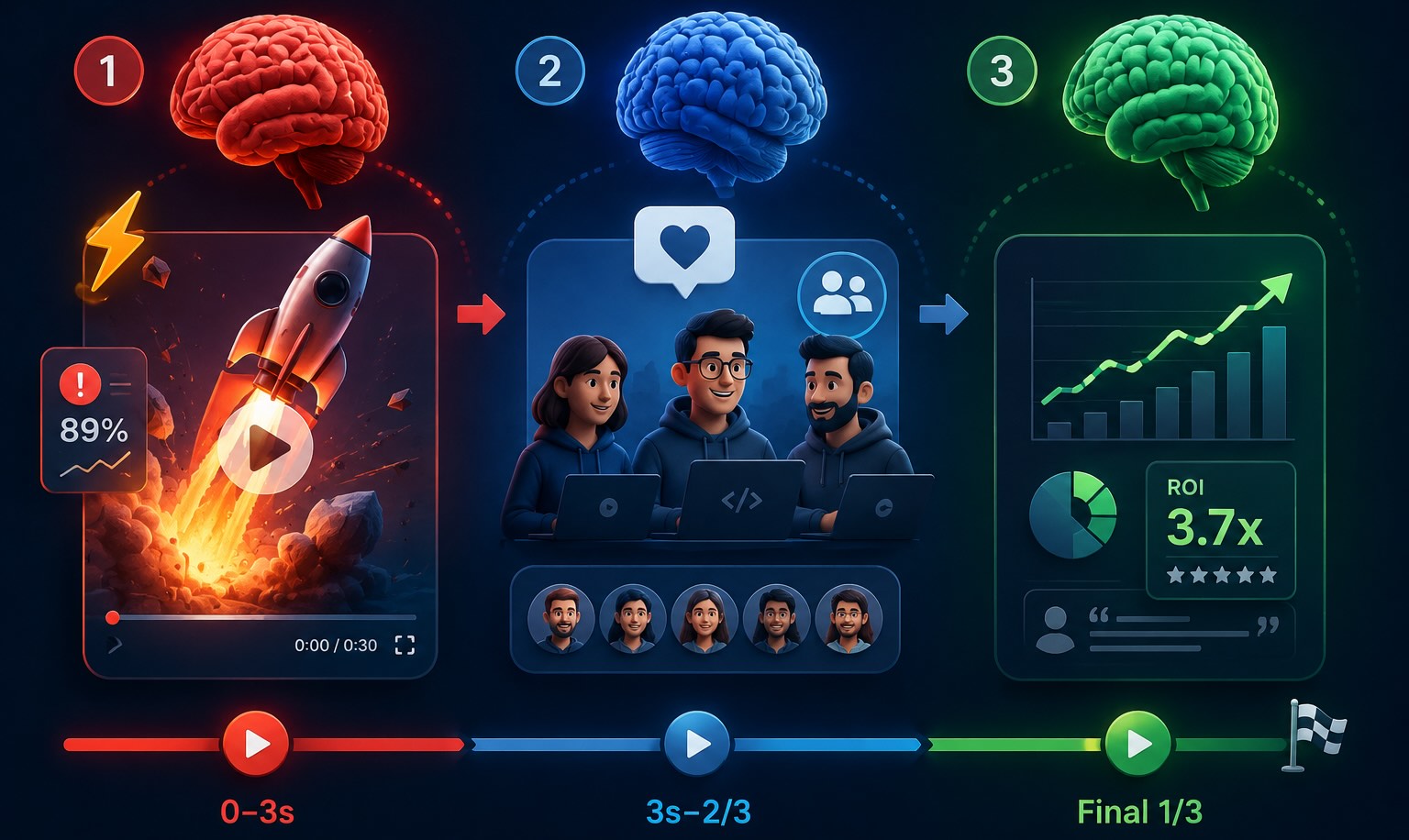
Most tech videos fail because they speak directly to the logical brain (the Neocortex) by immediately listing technical specs. Neurologically, your video must pass through three evolutionary gates to be accepted:
A Warning on Scarcity: Only use scarcity (e.g., "Limited beta spots") at the very end of the funnel. Using fake scarcity on cold traffic triggers instant distrust and kills long-term retention.
Your video is ending. What is your Call to Action (CTA)? If it’s just a button on screen saying "Sign Up," you are allowing the user's brain to take the easy way out: doing nothing (Omission Bias).
The Video Strategy:
End your videos with an Enhanced Active Choice. Force the viewer into an active psychological dilemma by framing the refusal as a tangible loss.
Instead of ending the video with:
End it with a visual split screen:
This forces the brain to slow down, engage System 2 analytical thinking, and realize the true cost of passing up your offer.
The best video content strategies for startups 2026 don't rely on guesswork. They rely on understanding the psychological friction of your buyer, and using the exact right visual medium—whether that’s a highly stylized 3D product teardown or a sleek 2D SaaS explainer—to melt that friction away.
Don't let a great product fail because of a bad psychological pitch.
Ready to launch? Discover how our dedicated video production for startups can help you drive mass adoption, and explore our proven psychological frameworks in action on the Lava Media Case Studies page.