Video Blog
How to Choose the Right Video Format for Your MedTech Startup
3D, AI, or Live Action

Sergey
April 24, 2026
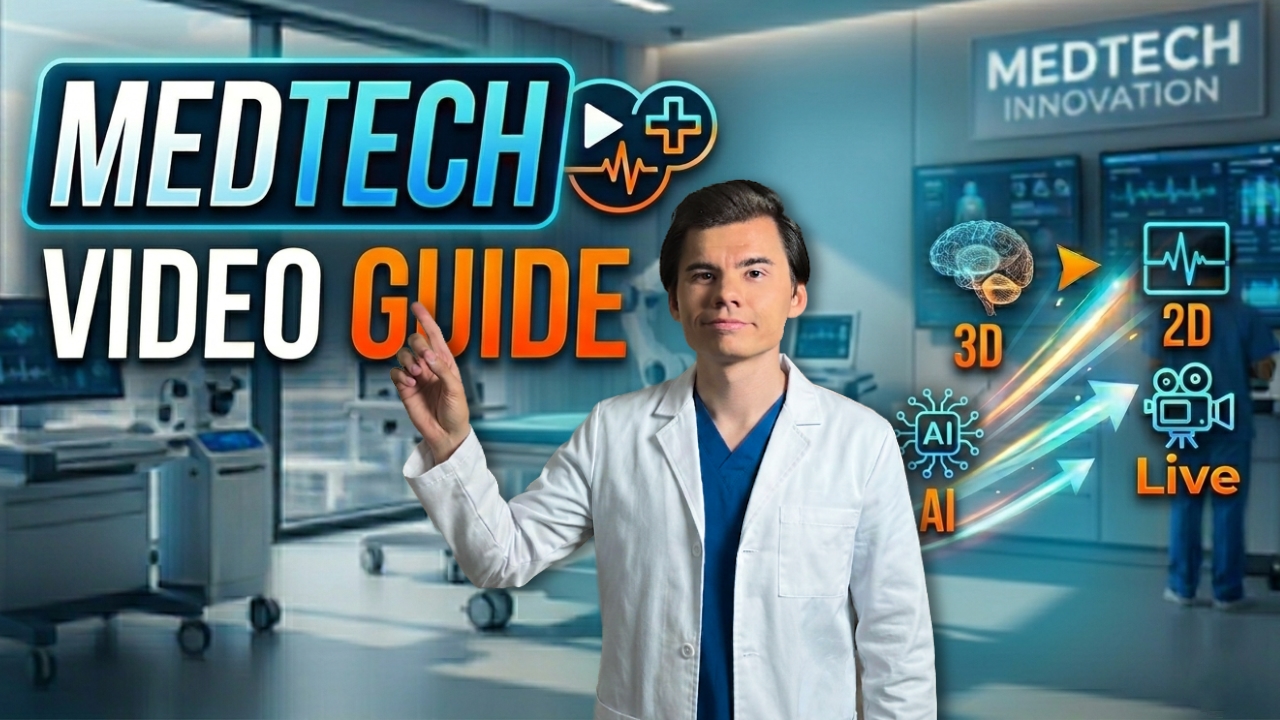
3D, AI, or Live Action

🎥 Prefer to watch instead of read?
We recorded a full episode on this topic, packed with real-world visual examples and case studies. Click the video below to see these formats in action!
3D animation, motion design, live-action filming, or Generative AI—today, MedTech marketers have more visual tools at their disposal than ever before. But when it comes to showcasing a complex medical device, a new pharmaceutical product, or a healthcare app, which format will actually drive ROI?
My name is Sergey Rodin, founder of the video marketing agency Lava Media. We specialize in creating and promoting high-converting video content, and we’ve partnered with global healthcare brands like 3M, Accu-Chek, and Fresenius Kabi.
In this guide, I’ll break down exactly how to choose the right video format for your MedTech startup based on your specific business goals, audience, and budget. Let’s dive in!
Before you start worrying about formats, cameras, or rendering engines, you need to establish your strategic baseline. We always ask our clients these three crucial questions:
Usually, an agency will curate visual references for you. But if you have a competitor's video or a specific style in mind, it’s crucial to communicate exactly what you like about it.
Agency Case Study: When we recently created a mood board for a client needing a 3D product model, we used two very different references.
By presenting these separately, we established clear boundaries: “We want the lighting from the first video, but the mechanical animation from the second.” Without this clarity, production can easily go off track.
The most common question we get from healthcare marketers is: "Should we shoot a live-action video, or rely entirely on graphics, stock footage, and AI?"
Here is our decision framework, based on two main factors:
Stop guessing your medical video budget. Here is the framework we use at Lava Media:
In the medical world, trust is your most expensive currency.
Sometimes, the narrative demands a live shoot. For example, in a project we produced for 3M, the marketing goal was to tie the product's reputation to a highly respected, real-life dentist. You cannot achieve that level of authentic industry credibility with AI avatars or stock models.
💡 PRO TIP: Build Authority with Real Faces
If your goal is Trust, you must film. When we produce videos for patients, showing a real doctor’s face creates more credibility than any 3D animation. Use stock to save money, but use real people to build authority.
Another example: We created a video specifically for stroke survivors. We needed a real doctor on screen because expert advice from a human carries immense psychological value for patients. To keep the budget efficient, we skipped complex graphics and used color-coded props on set. Red objects meant "remove this from the patient's house," and blue objects meant "keep this." It was simple, highly effective, and deeply human.
When marketers ask about AI, they usually want to cut costs on graphics or replace stock footage.
My rule of thumb: Only use AI to replace stock footage if you literally cannot find what you need. If your script requires a highly specific, futuristic medical lab or a multi-million-dollar MRI machine in the background that doesn't exist on stock sites—use AI.
But if your story features generic patients or doctors in a standard clinic, stick to premium stock footage. Over-relying on AI in these cases often overcomplicates the workflow.
Case Study: We recently needed a shot of a wearable medical device integrated onto a patient’s shoulder. We initially considered generating the entire scene with a neural network. However, it turned out to be much faster, cheaper, and more realistic to take high-quality stock footage of a human, build a precise 3D model of our device, and digitally "track" it onto the actor's shoulder in post-production.
⚠️ The Big Screen Warning:
Never use AI generation if your video will be displayed on massive screens (e.g., airport billboards or trade show booths). AI hallucinations, warping, and micro-glitches that look fine on a smartphone will look like a disaster on a 20-foot display.
If your goal is to showcase the form factor, internal mechanics, or precise functionality of a medical device, 3D animation is the only choice.
🎯 PRO TIP: 3D for Precision, AI for Vibes
Choose 3D animation when you need 100% control over the product. If you want to change a tiny internal component from metal to plastic, a 3D designer can do it in 15 seconds. An AI will take 3 minutes to 'think,' and it might hallucinate, change the wrong part, or mess up the lighting.
However, AI shines when dealing with abstract concepts. Let’s say you are marketing a cloud data storage solution for hospitals. The exact material of the hardware in the background doesn't matter to the viewer. For this, AI is perfect. You can quickly generate atmospheric hospital environments and overlay sleek 2D motion graphics to visualize data flow.
I am not against AI; I believe in using the absolute best tool for the specific job.
If a brand like Accu-Chek came to us today with a project we did years ago, I would propose a hybrid approach to maximize their budget:
Choosing a video format for your MedTech startup isn’t about chasing trends; it’s about solving a business problem.
If you are a marketing leader currently deciding how to visually package your MedTech or HealthTech product, reach out to us at Lava Media. We will analyze your go-to-market strategy, pull the right references, and help you produce a video that resonates with both physicians and investors.