Corporate
Brand Film Production for a Company Anniversary: 4 Concepts That Actually Work
Your Story. On Screen.

Sergey
May 15, 2026
Your company turns 30. Your CMO wants something "cinematic." Your CEO wants something "authentic." Your CFO wants something "justifiable."
All three are right. And all three are pointing at the same thing: a branded documentary — a format that's quietly becoming the most powerful instrument in the corporate communicator's toolkit.
This isn't about producing a slick reel to loop at the gala dinner. Done right, a brand film production for a company anniversary is a strategic asset that outlives the celebration by years — deepening employee belonging, sharpening brand identity, and telling a story no competitor can replicate.
Here's how to think about it — and four production concepts at very different scales and budgets.
Most corporate content tries to say something. An anniversary brand film gets to prove something — because the raw material is already there.
Decades of real decisions. Real crises survived. Real people who gave years of their careers. Real product breakthroughs that changed the company's trajectory. You don't need to invent a narrative. You need to find the one that's been accumulating in your archives and your people's memory.
That's what makes corporate documentary production different from a product video or a recruitment clip. The story has texture, contradiction, and time — and audiences, whether employees or external stakeholders, feel the difference immediately.
Experts on corporate storytelling identify five core messages that resonate during an anniversary:
The future, rooted in the past. The most effective anniversary narratives aren't retrospective — they're prospective. The technique is to start from where the company is going, then find the historical moments that prove it's capable of getting there.
Purpose beyond profit. An anniversary is the best possible moment to remind employees why the company exists beyond its financial targets. Historical achievements become proof points for stated values — not marketing claims.
People made this. The success of the company is inseparable from the specific humans who built it. Documentary storytelling honors this in a way that a corporate slide deck never can.
The honest version of the story. Modern employees are allergic to curated mythology. A corporate documentary that avoids the hard years, the failed bets, and the moments of genuine doubt will feel hollow. The struggles aren't a liability — they're what gives the story credibility.
Belonging for everyone. The most effective anniversary content makes a first-year employee feel as connected to the company's history as a founding partner. That's a storytelling challenge, not just a production challenge.
The flagship format for companies ready to create something lasting.
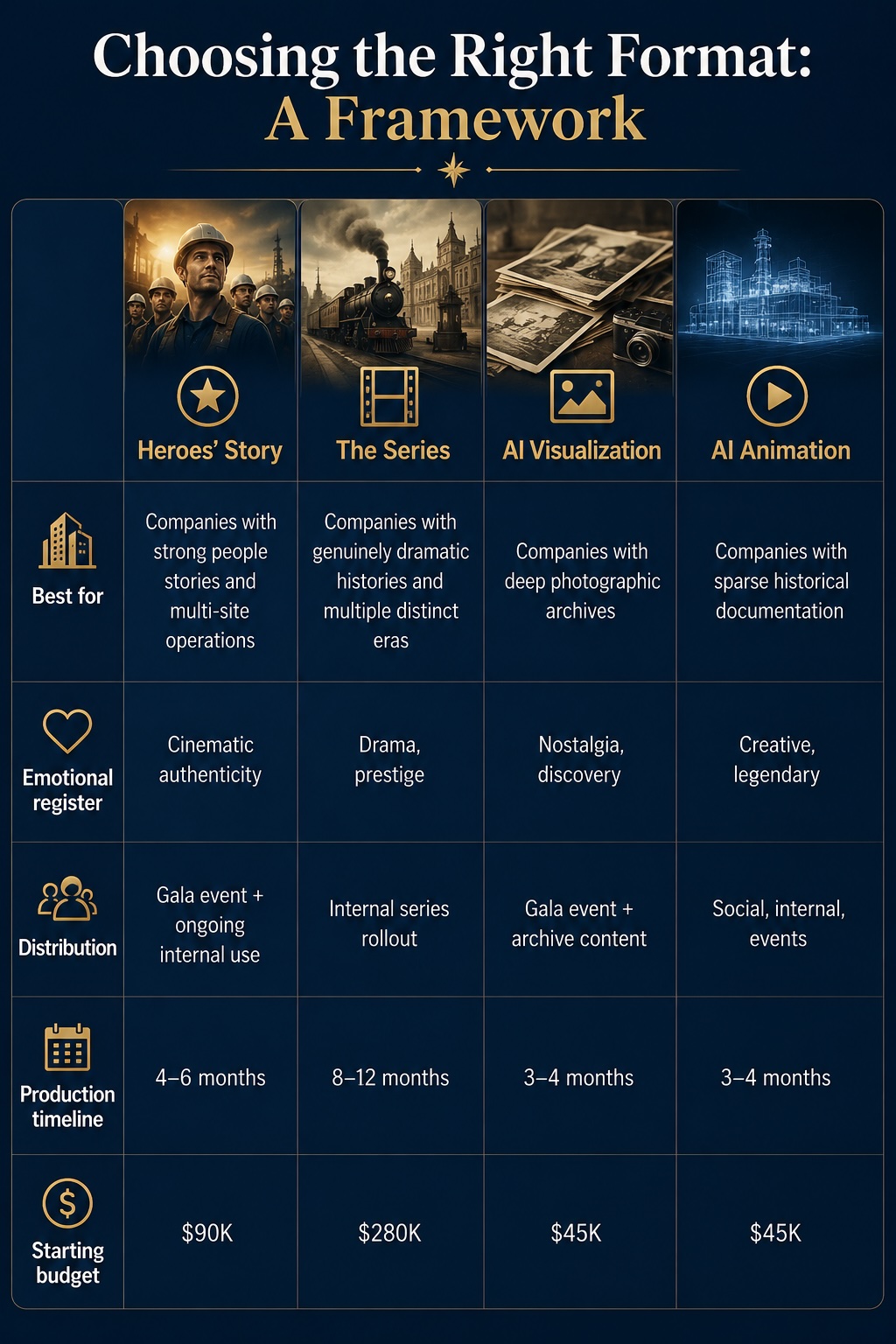
A 35–40 minute branded documentary told through the voices of everyone who built the company — from C-suite to frontline staff. Archive footage, talking-head interviews, observational footage across your facilities, motion graphics layered over historical photography. Shot like a film, not a corporate video.
This is the documentary-style brand video format that defines the genre: cinematic framing, sound design that creates atmosphere, a structure that builds tension and delivers genuine emotional payoff. Think less "annual report" and more "Netflix documentary about a company you'd never heard of but can't stop watching."
The key storytelling principle: no golden-age mythology. The most powerful version of this film tells the truth — including the years that nearly broke the company. Those moments are what transforms a promotional asset into something employees will actually watch, share, and feel pride in.
Production scope for this concept typically spans 5 key facilities across multiple cities. The logistics are significant; the result is a document of the company that will still be relevant in 20 years.
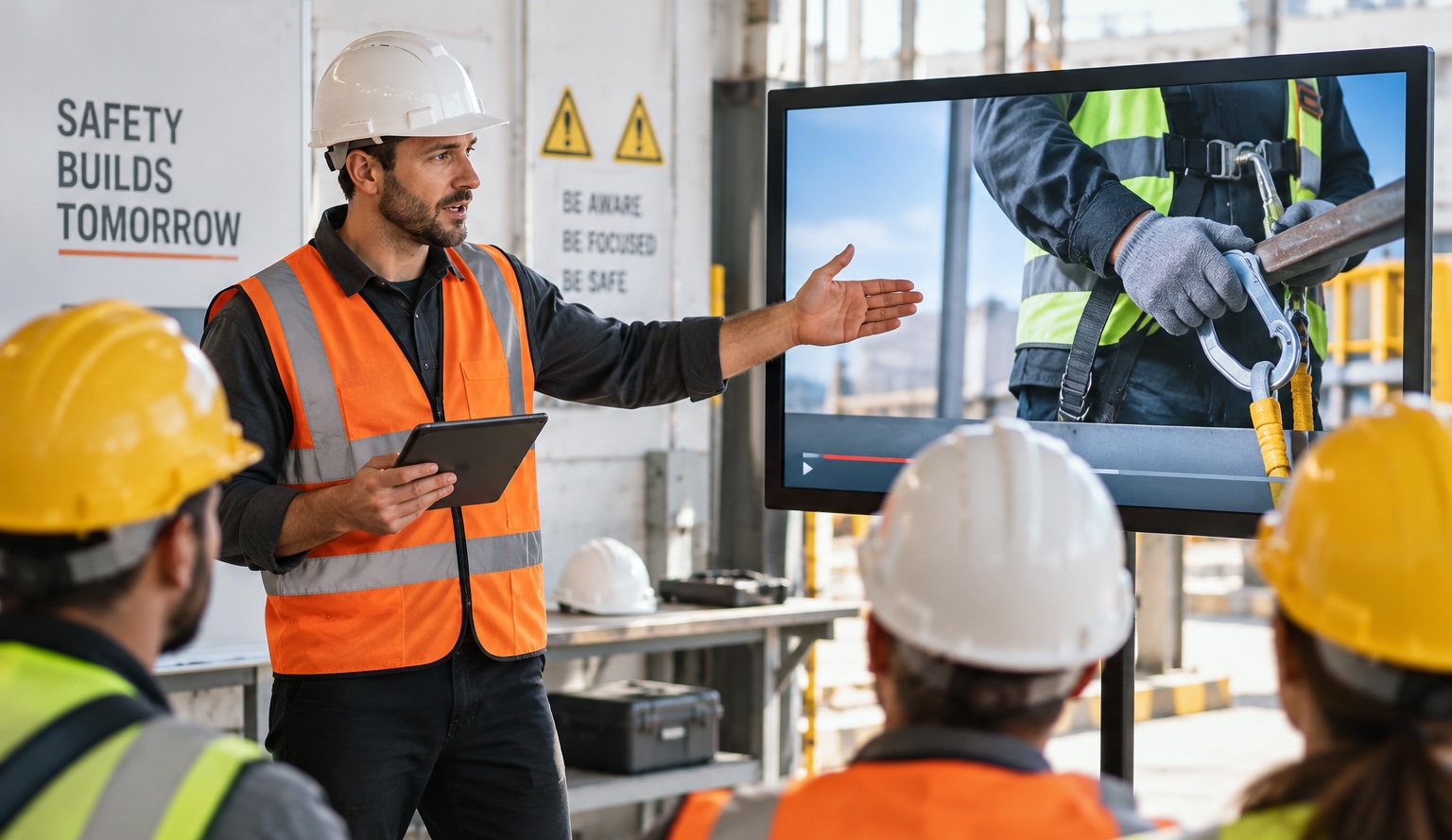
An example of storytelling and a picture:
Starting from: $90,000
Explore Lava Media's corporate video production →
For companies with genuinely dramatic histories.
Every significant company has distinct eras — a founding chapter, a growth explosion, a near-death experience, a reinvention. The Series format treats each of these as an episode: 5–7 episodes, 15–20 minutes each, with actors, scripted drama, and production values borrowed from prestige television.
This is creative brand film production at its most ambitious. You're not just documenting history — you're dramatizing it. Real events, fictionalized through casting, performance, and cinematic production design. The documentary layer provides authenticity; the drama layer provides engagement.
An example of an approach to producing a series (production and storytelling level):
The storytelling framework maps naturally to the classic narrative archetypes: Quest (the founding mission), Rags to Riches (the growth chapter), Rebirth (the transformation period), Overcoming the Monster (the competitive or existential crisis). Each episode becomes a standalone viewing experience that can be released across your internal channels as an ongoing series — creating sustained engagement rather than a single commemorative moment.
Starting from: $280,000
The high-impact option for companies with deep photographic and film archives.
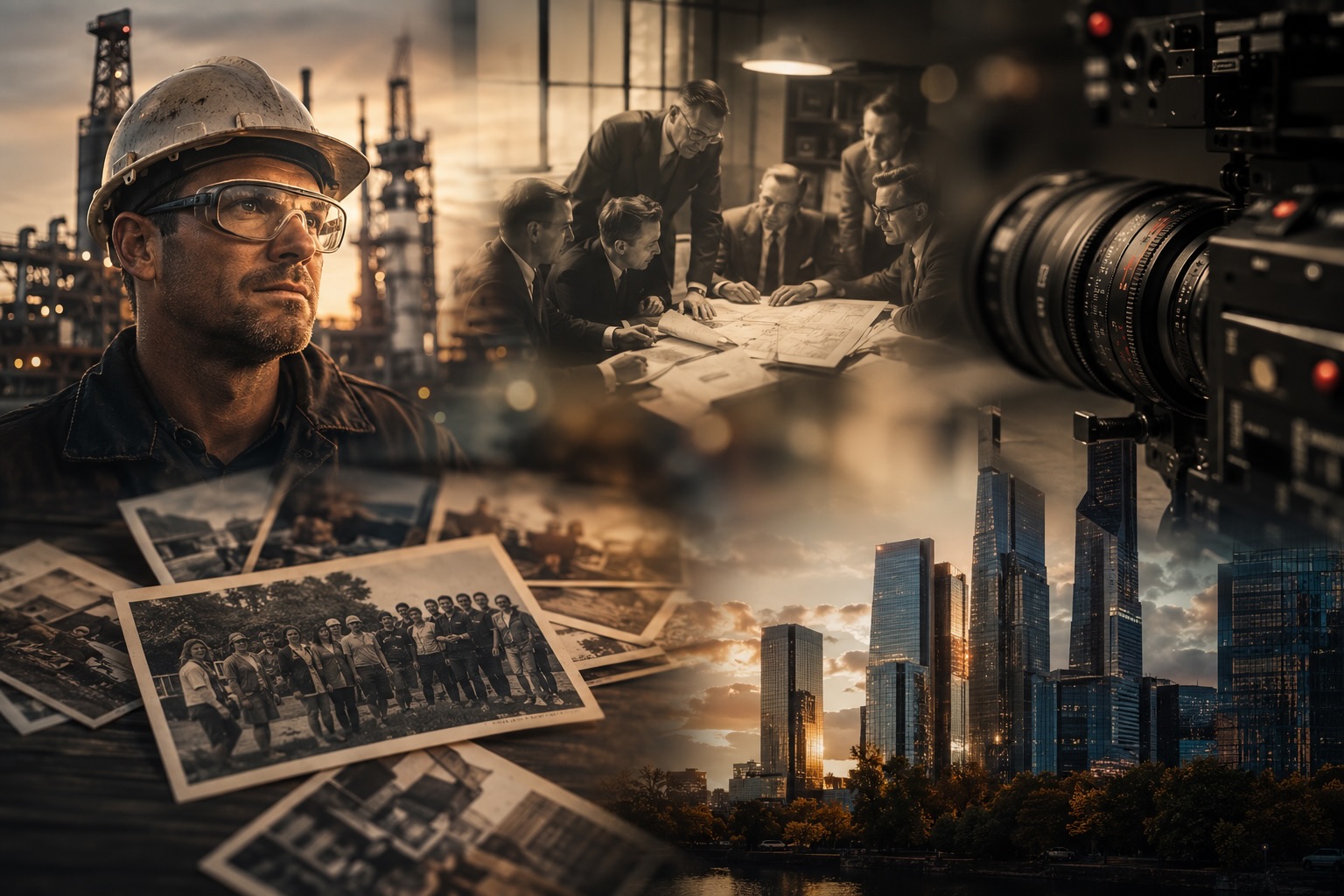
Take the storytelling architecture of the Heroes' Story — cinematic interviews, personal narratives, employees across facilities — and layer in something that wasn't possible five years ago: AI corporate video production that animates static archive material.
Old photographs move. Still frames become immersive environments. Moments that were frozen in time suddenly breathe.
This is the AI video production format that's changing what's possible in corporate documentary work. The production is less logistically intensive than the full cinematic Heroes' Story — fewer camera setups, a slightly lighter production footprint — but the visual effect of seeing historical photographs come alive creates an emotional impact that's uniquely powerful for an anniversary context.
For companies with rich archives — decades of photography, old film reels, newspaper clippings — this format unlocks material that would otherwise just sit in a server somewhere.
Example of AI revival:
Starting from: $45,000
The most flexible format for organizations that want to control the visual world entirely.
The structural approach is identical to the Heroes' Story: employees speaking directly to camera, narrating the company's journey in their own words. But the retrospective footage — everything before the present day — is rendered entirely in AI-generated animation.
The style can be chosen to match your brand: painterly illustration, graphic novel aesthetic, hand-drawn, photorealistic. The past becomes a visual world you design from scratch; the present is live action. The contrast between the two registers creates a natural narrative rhythm — history as legend, present as reality.
This is particularly effective for companies whose early years are poorly documented visually, or whose founding story happens to be inherently cinematic (a garage startup, a single founding moment, a dramatic first year).
The production timeline is more compressed than live-action formats, and the cost is significantly lower — making this the entry point for organizations that want genuine creative ambition without a six-figure budget.
You can choose any drawing style you want; here are a couple of examples of what can be "copied" with AI:
Starting from: $45,000
Regardless of which concept you pursue, the following principles separate anniversary content that moves people from anniversary content that simply occupies screen time.
Start from the future, move backward. Define where the company is going in the next decade. Then find the historical evidence that proves it's capable of getting there. This reframes the film from "look how old we are" to "look what we've built, and where it's taking us."
Find the conflict. Stories without stakes are not stories — they're chronologies. What were the moments the company almost didn't survive? What bets didn't pay off? What needed to change? These are the narrative engines that make viewers care.
Let the people speak. The most powerful anniversary content features real voices — including frontline employees, not just leadership. When a warehouse supervisor or a customer service rep articulates what the company means to them, it does more for culture than any executive speech.
Honor individual contributions, not just collective milestones. The "two-track" approach: celebrate the company's history, but make visible the specific people and teams whose work shaped it. Recognition that names real impact creates belonging at scale.
End forward. Whatever format you choose, the emotional resolution should be about what comes next — not what was. Leave employees with optimism, direction, and a sense that the best chapter of the story hasn't been written yet.
The golden-age myth. Employees who lived through difficult periods will disengage from any narrative that pretends those periods didn't happen. Authenticity requires acknowledging the hard years.
Executive-only casting. If every speaker in your anniversary film is a senior leader, you've told employees exactly how much their perspective matters.
Treating the anniversary as a one-day event. The most effective anniversary strategies build toward the milestone over months — internal campaigns, teaser content, historical archive releases — and continue after it, using the film as an ongoing asset.
Production shortcuts. A poorly produced anniversary film signals something damaging: that the company didn't think its own story was worth investing in. Broadcast-quality production values aren't vanity — they're a message about how seriously you take your identity.
An anniversary brand film production project at this scale requires more than a production crew. It requires a creative partner who understands corporate culture, can conduct meaningful interviews with employees at every level of an organization, knows how to structure a documentary narrative, and has the technical capability to deliver cinematic results across multiple production locations.
Lava Media's corporate video team has produced documentary-style brand content for companies across industries — from manufacturing to technology to financial services. We bring full-cycle capability: creative development, scripting, multi-city production logistics, post-production, and distribution strategy.
If your company has an anniversary on the horizon, the conversation about format, scope, and budget is best started early — ideally 12 to 18 months before the milestone date. The best anniversary films aren't produced under deadline pressure. They're made with the patience the story deserves.
Related: Corporate video production → · AI video production → · TV commercial production →