Idea
How to Make a High-Impact Startup Launch Video for Investors
You have 60 seconds.

Sergey
May 13, 2026
You have 60 seconds. That's roughly how long a VC will watch your video before deciding whether to keep going or click away. No amount of traction slides or market-size tables will buy you those seconds back. But the right startup launch video will.
If you're approaching a Seed or Series A round, video isn't a nice-to-have. It's the difference between a warm intro and a cold pass. This guide breaks down exactly what separates an investor-grade launch video from the kind that quietly kills your fundraise.
Need a production partner who speaks VC? Lava Media's startup video production team has built high-impact launch videos for tech startups across every stage — from pre-seed demos to Series A decks.
The human brain processes visual information 60,000 times faster than text. A polished, cinematic launch video doesn't just convey your story — it proves you can execute. Investors aren't only evaluating your product. They're evaluating you.
A well-crafted startup pitch video signals three things simultaneously:
None of that happens with a screen-recorded demo and a stock music track.
The most effective tech startup launch video production follows a precise structure. Think of it less like a commercial and more like a compressed pitch deck — with the emotional velocity of a film trailer.
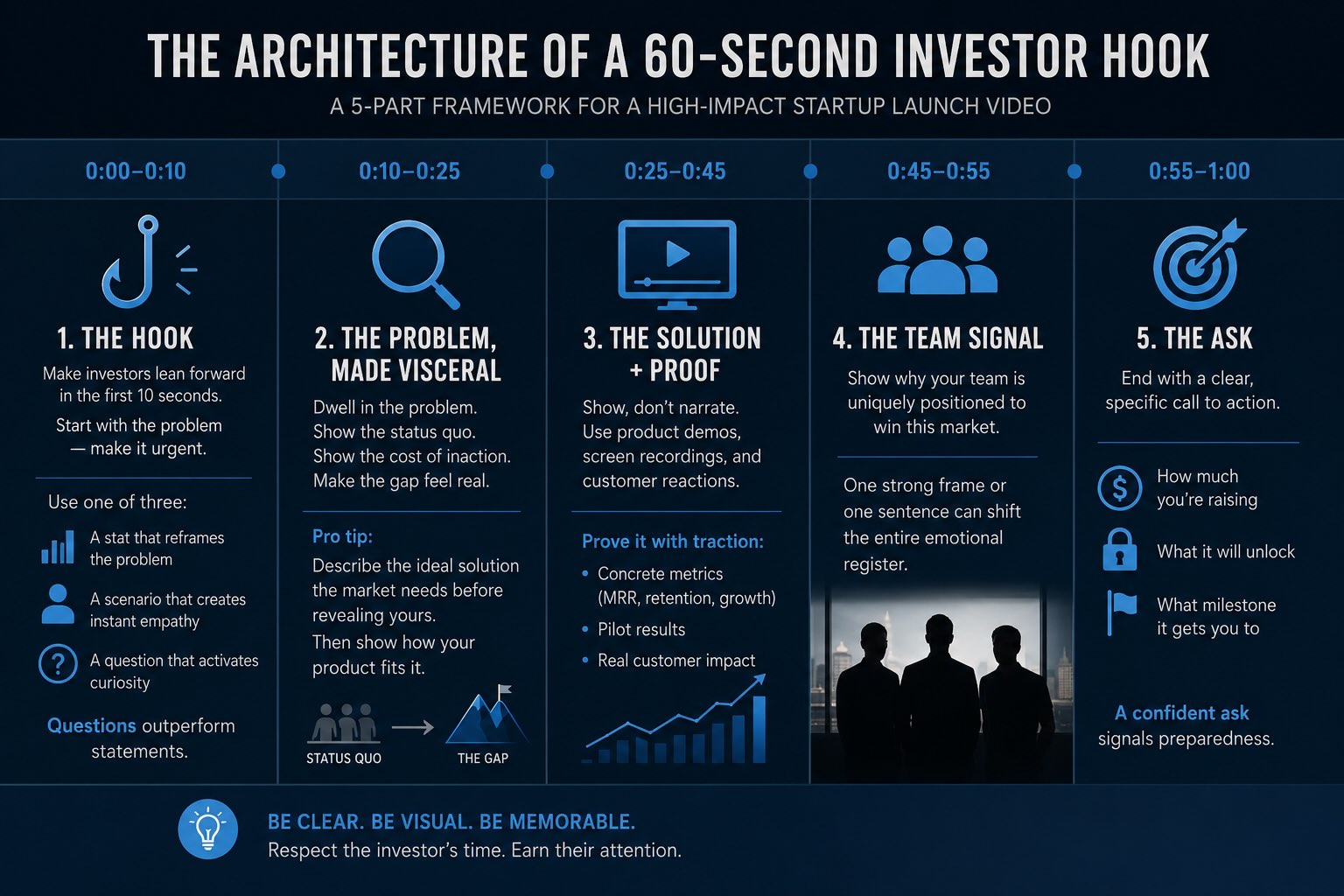
You have 10 seconds to make an investor lean forward. Don't introduce yourself. Don't announce your company name. Start with the problem — and make it feel urgent.
The best hooks answer an implicit question investors are always asking: "Why does this need to exist, and why right now?"
A powerful hook uses one of three approaches:
Note that questions outperform statements here. When an investor's brain formulates the answer, they own the insight — and they're far more likely to believe it.
Don't rush to your solution. Dwell in the problem just long enough to make the gap feel real. Show the status quo. Show the cost of inaction. Make the absence of your product feel painful.
One advanced technique: describe the ideal type of solution before revealing yours. Frame what the market actually needs — then show how your product fits that exact description. It preserves your objectivity and makes the argument far more persuasive.
Now you introduce the product. But here's the critical rule: show, don't narrate. Screen recordings, product demos, customer reactions — any of these are worth more than a voiceover describing features.
If you have early traction, this is where it lands hardest. Not vague metrics like "strong engagement," but concrete numbers: MRR, retention rate, pilot results, revenue growth curve. A brief on-screen graphic is worth more than three sentences of voiceover.
Investors at the Seed and Series A stage are often backing people more than products. A single frame — a tight shot of the founding team, a key credential, a shared origin story — can shift the entire emotional register of a pitch video.
You don't need a full bio reel. You need one sentence that answers: "Why is this team uniquely positioned to win this market?"
End with a clear, specific call to action. How much are you raising? What will it unlock? What milestone does this round get you to?
Vague closings ("We'd love to connect!") signal that you haven't thought through your round structure. A confident, specific ask signals the opposite.
This is where most startup founders make their biggest mistake.
A cheap template animation — the kind any freelancer can produce in a week for $500 — doesn't just fail to impress investors. It actively signals that you either lack taste, lack resources, or lack judgment about how to allocate both. Any of those is a red flag.
Cinematic production quality communicates something that no amount of financial modeling can: this team understands what "great" looks like.
What does investor-grade visual language look like in practice?
Motion graphics that reinforce narrative, not decorate it. Every graphic element should do work — visualizing a data point, simplifying a complex mechanism, or reinforcing a brand claim. Gratuitous animation is noise.
Lighting and color that signal brand maturity. Dark mode with neon accents reads differently than warm naturalistic tones. Neither is right or wrong — but both are choices that communicate your brand's personality. Make the choice deliberately.
Tight editing rhythm. The pace of your cuts should mirror the energy of your product. A fast-moving fintech platform should feel different from a deep-tech infrastructure play. Rhythm is a product signal.
Subtitles. Non-negotiable. A significant portion of investors will watch your video on mute. If your key message disappears without audio, you've lost the frame.
Experienced VCs make pattern-matching decisions in the first 150 milliseconds of an interaction. Your video isn't just communicating your pitch — it's communicating your archetype as a founder.
Research on investor psychology identifies three founder archetypes that attract capital: the Showrunner (experienced operator with commanding presence), the Artist (obsessively creative, product-first), and the Learner (hungry, coachable, authentic). Each can succeed. What kills deals is coming across as the desperate Salesperson — overproducing the hype while underdelivering on substance.
The antidote is specificity. The details that no AI can generate and no competitor can fake: your founder's actual voice, real customer quotes, specific operational insights from building in the field. These signals separate a genuine pitch from a polished pitch deck with a play button on it.
Before you write a single line of script, ask yourself: what one word should an investor associate with your company after watching this video?
The best tech startup launch videos are engineered to own a word in the investor's mind. The way Google owns "search." The way Slack owned "work." The way Stripe owns "payments."
Every visual choice, every sentence, every graphic should be in service of that one word. If you can't name it, you're not ready to shoot.
One of the most common challenges we encounter in startup video production is this: the product is genuinely powerful, but explaining it to a non-technical investor in under 60 seconds feels impossible.
That was exactly the challenge with AMPD. The technology was sophisticated — layered infrastructure that didn't translate well into a simple demo screen. The risk, without careful visual strategy, was a video that felt impressive to engineers and opaque to everyone else.
The solution was to lead with the business outcome, not the technical mechanism. We built the visual language around the impact — what changes for the customer, what the market looks like before and after, what the competitive gap actually is. 3D motion graphics did the translation work: turning abstract backend logic into a tangible, credible story.
The result was a video that investors could follow without a technical background — and that engineers felt proud of. That's the bar.
Leading with the solution before the problem. Investors need to feel the pain before they'll value the painkiller.
Claiming you have no competition. This signals either dishonesty or ignorance. Acknowledge alternatives — including "doing nothing" — then explain clearly why you win.
Overpromising market size. "We're going after 1% of a $10T market" is a cliché that experienced investors roll their eyes at. Use bottom-up market sizing based on realistic customer acquisition economics.
Generic animation. If your video looks like a $300 Fiverr job, investors will wonder what your product looks like.
A weak or missing ask. If you don't tell investors exactly what you need and what it will accomplish, you're leaving the most important frame blank.
A startup launch video is not the place to cut costs. This is your first impression with people who may write you a $2M check. The production values of your video are, for many VCs, a direct proxy for your judgment as an operator.
That doesn't mean you need a Hollywood budget. It means you need a production partner who understands both the craft of video and the psychology of investor communication — a team that knows what a partner at Sequoia responds to differently than what your customers do.
Lava Media is a startup video production agency that specializes in exactly this. We've worked with tech startups from pre-seed through Series A, helping founders translate complex products into cinematic, investor-ready stories. If you're approaching a fundraise and need a launch video that does real work — not just looks good — let's talk.
Related: How we helped a SaaS company package a complex B2B product for enterprise sales with custom animated explainer video · AI video production and 3D motion graphics case study · Medical device 3D animation case study