Video Blog
NASA’s 9-Year Marketing Plan: Video Strategy Secrets for Tech Brands
Lessons in B2B Video Marketing

Sergey
April 9, 2026
Lessons in B2B Video Marketing

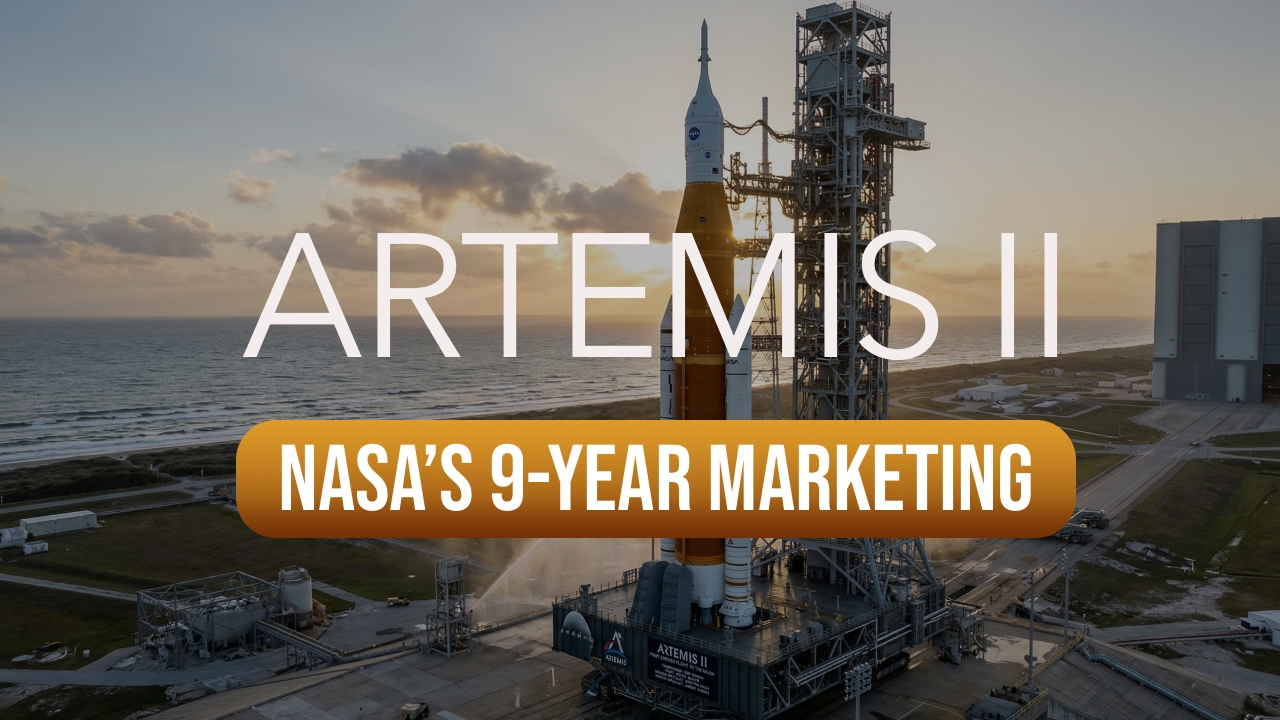
The Artemis II mission captured global attention. While it is a monumental human achievement, there is a sophisticated marketing strategy behind this triumph. NASA began preparing its audience for this moment 9 years ago, and video content was the cornerstone of that communication.
Using Artemis II as a case study, I’ll show you how to build a video marketing strategy for your technical brand. It’s not about the size of the budget—it’s about strategy and consistency.
Prefer watching over reading?
One might think "everyone already trusts them." However, in the High-Tech sector, the cost of failure isn’t just financial—it’s a total loss of reputation. For NASA, video is a way to say: “Look, we’ve thought of everything; we’re monitoring every single bolt.”
In B2B, it works the same way: by showing the creation process, you build trust. There are no boring projects—only untold stories.
Many startups keep their goals trapped in the founders' heads or buried in pitch decks during the MVP stage. NASA, on the other hand, announced its plan for a new lunar mission over 10 years ago and immediately released a high-quality animated video explaining the program, mission, and goals.
The Insight: The general public won't grasp hundreds of technical nuances. NASA’s communication defines “anchor points” that are easy to understand: the launch, stage separation, Earth orbit, and the lunar flyby. Do the same: identify the clear stages of your project and visualize them.
A marketer must understand that every target audience requires a specific style.
Note how the style shifts: cinema-grade equipment, professionally lit locations, and photorealistic 3D renders of the Moon and astronauts. This sets an entirely different tone for the dialogue.
Pro Tip: NASA created its own video portal, NASA Plus. I always say: a B2B brand is practically obligated to have a video gallery on its own website. This is your "showroom of expertise."
If your product is complex code or internal hardware, use 3D graphics. NASA showed the Artemis II flight in 3D a full year before the actual launch. The realism is staggering, and it answers all the questions about "how it will work."
NASA releases video bios of the Artemis II crew. You might think you don't have "astronaut-level" heroes in your team? I’d say you haven’t looked hard enough.
Any team member—from a junior developer to the founder—can become such a hero. Tell their story: why they do what they do, how their childhood influenced them, and what personality hides behind their formal title. It humanizes the technology.
NASA strictly separates its production styles:
You don’t always need a full film crew. Sometimes a Short filmed on an iPhone in the middle of a workflow creates more connection than a polished commercial.
NASA surprised everyone by launching a 12-hour live stream... not of the launch, but of a rocket fueling test. This content builds a sense of community and shared experience.
Also, consider the 360° format. It’s perfect for industrial production—you can film your main facilities this way and embed it into your site with brief explanations.
Many startups wait for a final product to start talking. NASA does the opposite.
NASA doesn't just talk to scientists. They go where the general public is.
NASA doesn't just post the same video everywhere; they adapt the content for every specific platform.
Nothing confirms technical superiority like footage that is impossible to capture by any other means.
No victory should go undocumented.
The Artemis II case proves one vital thing: video marketing is a long game. Trust is built over years.
If you feel your brand is ready to reach orbit but you don’t know where to start—reach out to us at Lava Media. We’ll package your vision into a strategy that works as precisely as the engineers at Mission Control.
Ready to launch your brand’s mission?
Whether you need the high-end authority of a 3D Video, the strategic clarity of 2D Animation, the cutting-edge innovation of AI Video, or a full-scale Corporate Film to tell your brand's legacy—we do it all.
At Lava Media, we specialize in visualizing the impossible and turning complex tech into high-converting assets.