
TV
Why FinTech Brands Need Video — and Which Kind Actually Works
Trust Can't Be Faked

Sergey
August 28, 2026
FinTech doesn't sell a feature — it sells trust that people will hand this brand their money. Text can't carry that kind of trust: people either feel "I can believe this" on a gut level, or they don't. Video for fintech and cybersecurity is one of the few formats that can build that feeling directly.
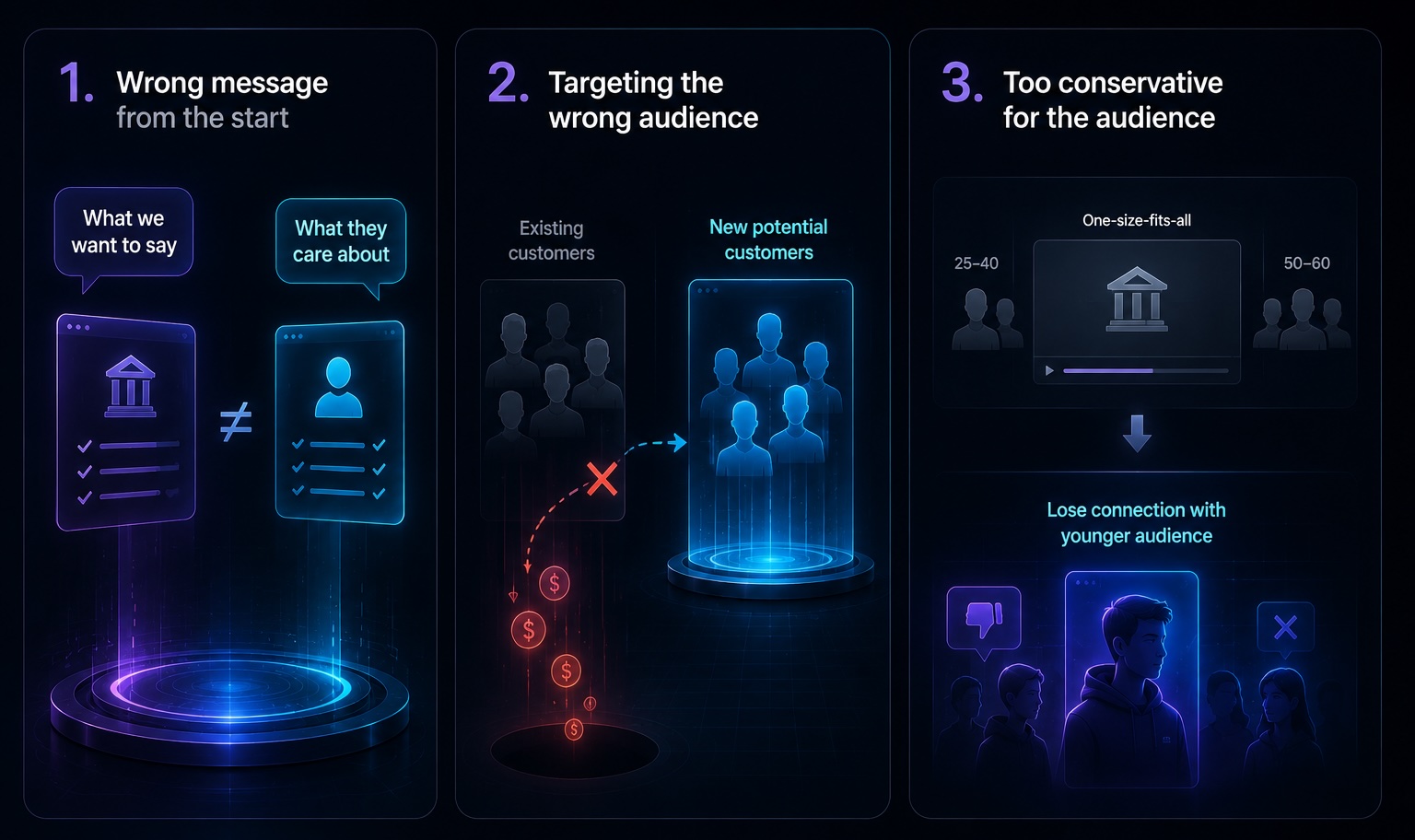
There's no universal rule that says one style of delivery builds trust and another doesn't — it all depends on the audience, the format, and where the video runs. But one principle holds up almost everywhere: the more mainstream and conservative the audience (TV, for instance), the calmer and more restrained the creative needs to be. Online, the boundaries stretch further, but even there, leaning too hard into trends or humor is risky — an unserious tone can damage a fintech brand's reputation more than it would in almost any other category.
The difference between creative that works and creative that doesn't shows up clearly in two well-known payment-app commercials.
In the Apple Pay spot, a woman is running through what looks like some kind of chaos — almost end-of-the-world territory — and pulls into a gas station. At the register, she doesn't have her card on her. There's urgency, there's a rush, the cashier barely registers what's happening around him — and she pays with Apple Pay. Whatever's happening in the background doesn't distract from the message — it reinforces it: urgency, no card on hand, tap to pay, done. The device serves the point.
Samsung Pay's spot runs into the opposite problem. It has characters searching for their cards, and a dancing character paying with his watch. But the dance sequence pulls so much focus that at a certain point it almost reads as if the dancers are paying for the people who can't find their cards. The creative takes center stage, the brand benefit slides to second place, and the actual message gets lost behind the spectacle.
The takeaway: the flashier and more attention-grabbing a secondary idea in the spot, the higher the risk it eats the main message instead of supporting it.
A major bank secured a sponsorship slot at a business forum — screen time for a commercial in front of the room — but found out only 1.5 weeks before the event. The brief: promote a new joint-account feature in the bank's mobile app, aimed specifically at the forum's business audience, not a mass-market viewer. We took the client's rough creative draft and turned it into a finished 30-second spot inside that tight window.
Full details in the Major Fintech Bank case study.
For that project, we shot with a live actress instead of generating the spot with AI — a deliberate choice, not a default. We could have prompted a model with something like "a smiling woman picking out a dessert on her phone," and it would deliver. But the result would look generic and predictable. At the six-second mark in the finished spot, the actress's smile actually says "I'm dreaming about this dessert" — you read it in the faint dimples at the edge of her smile and the small movement of her lips. Those micro-expressions are exactly where current video generation still falls short; that level of genuine empathy is still something only a live actor delivers.
That said, AI isn't the enemy here — it's one tool in the mix. Facial realism and micro-expression accuracy aren't yet at the level of a live actor, and fintech carries an extra risk on top of that: AI-driven scams are widespread right now, and audiences are already wary of anything that reads as synthetic. If a viewer clocks a spot as AI-generated, that association with scam content can stick — a direct reputational risk for a financial brand. The safer combination is a live actor carrying the core of the spot, with AI used for specific creative inserts or effects. Matching the right tools to the idea is the production agency's job, not a one-size-fits-all rule.
How much does video cost for a fintech brand?
It depends on format and complexity — from adapted animation to a full live-action shoot with casting. Full pricing breakdown in our video production cost guide.
How long does production take?
It can be very fast — the bank case study above went from brief to finished spot in 1.5 weeks under a hard event deadline. A less urgent timeline typically runs longer.
Can fintech video be produced entirely with AI?
Technically yes, but with caution. The main risk: if the audience reads the spot as AI-generated, it can trigger a scam association — something worth avoiding in financial services specifically. A hybrid approach (live actor plus AI-assisted inserts) is usually the safer route.
Does the bank's legal or compliance team need to sign off on the video?
Yes — for financial products, that's a standard part of the process. Language around product terms, rates, and guarantees typically goes through legal review before final cut, so it's worth building that step into the project timeline from the start.
Does this format work for events and trade shows?
Yes — as in the bank case study, the spot was built specifically for large-screen playback at a business forum. See also our trade show video production.
Need video for a fintech brand? See what we build for fintech and cybersecurity, and reach out with your brief.