AI
Top AI Platforms for Creating UGC Brand Videos & Ads in 2026
An Insider’s Guide

David
June 15, 2026
If you’re a marketer in 2026, your feed is likely flooded with AI-generated content. But let’s be honest: most of it looks like plastic. When marketing directors come to me looking for reviews of ai ugc video platforms for enterprises, they are usually searching for a "magic button" solution.
This is David—Art Director and AI Video Creator for business and тI’m going to tell you straight up: the magic button doesn't exist yet. But if you know how to build the right pipeline, you can create AI-generated User-Generated Content (UGC) that actually converts.
Here is my unfiltered breakdown of the tools, the workflows, and the harsh reality of AI video marketing right now.
To get good UGC, you need a mix of tools. Kling is performing very well right now, specifically their 4K version—it helps a lot with high-res base generations. We also used a lot of Veo (specifically Veo 3.1) in the past for UGC, but honestly, it’s no longer the absolute best option out there.
Right now, the game is all about custom "skills" and node-based workflows. To get a high-quality result, you can't just type a prompt. You need to "bake" your own visual skills (custom models/workflows) or hunt for them online. Currently, the market is a bit empty, but I expect we’ll soon see marketplaces selling visual and stylistic templates specifically for UGC. Some platforms are trying to offer built-in UGC templates, but they are often clunky.
Technically, a good result depends on multiple factors aligning: you need a powerful LLM to interpret the prompt, and a very strong video generation model to execute it.
Honestly? None of them. I never use out-of-the-box, ready-made solutions for UGC content.
The AI tooling landscape is evolving so rapidly that any "all-in-one" platform becomes obsolete within months. There is zero sense in relying on a closed ecosystem for UGC. You are much better off creating your own custom creatives.
Especially now, there are so many node-based tools available. When you build your own pipelines, you accumulate a base of custom assets and workflows. You can then use that foundation for future experiments and seamlessly upgrade your tools as new open-source or API models drop.

Out of the purely commercial avatar platforms, HeyGen is the one I know best and respect. They’ve been in the game for a long time.
Initially, they were focused purely on creating high-quality, static avatars with excellent lip-syncing for dubbing and automated content—not necessarily dynamic, unique content in various locations or states.
But they’ve evolved. Now, they are integrating scene movement features. You can plug in modules that allow your character to actually move around, change backgrounds, and interact with the environment. I haven’t tested these newest dynamic features deeply myself, but I know the capability is there. HeyGen is a strong tool for what it does, but it's a different beast than raw, generated UGC.
The biggest difference between standard AI video and UGC is imperfection.
To make it look like a real influencer shot it on their iPhone, the footage needs to be noisy. It needs to be flawed.
Here was my go-to pipeline (and one I'll likely return to): I used to use Sora (which you can still find on various aggregators) to generate a base video fragment. But I wouldn't use the video as-is. I would extract a single frame from that video, take it into an editor, and intentionally "ruin" it—adding noise, grain, and imperfections to make it look like a raw smartphone camera capture.
Once I had that imperfect, "noisy" anchor image, I would feed it into other AI animation tools to bring it to life. Generating a perfectly messy image from scratch is incredibly difficult for AI—it always wants to make things pretty. You need to give it a flawed reference image to work from.
As I mentioned with my Sora pipeline, you have to control the aesthetic. The best way to do this at an enterprise level is to create a "style map."
You gather your own dataset of raw, authentic influencer content, train a custom skill/model on it, and "bake" that style map into your generation process. The ultimate secret to lifelike AI UGC is relentlessly mimicking the unpolished, chaotic look of a real blogger.
This brings up an interesting point when we compare ai-driven vs traditional ugc video platforms.
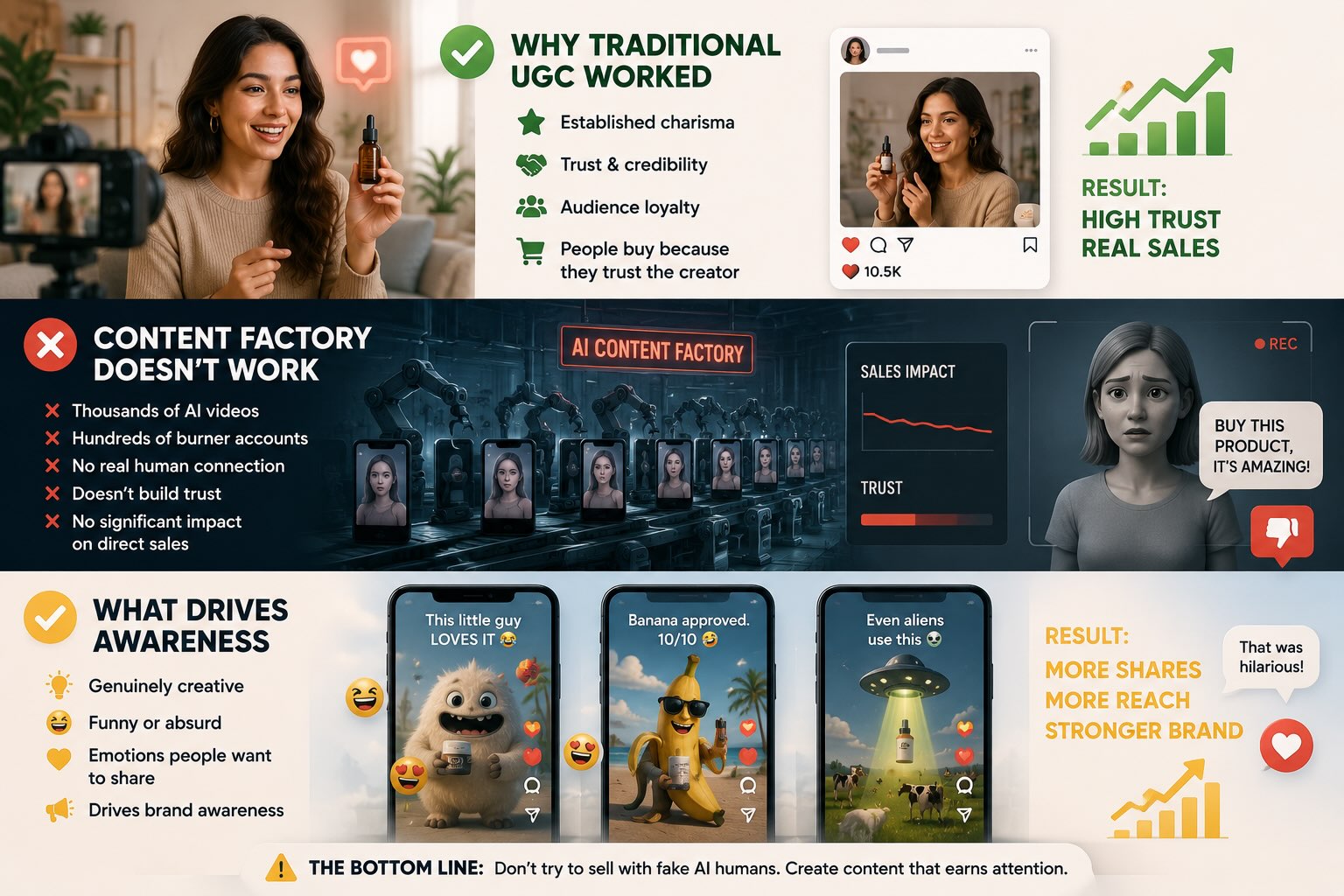
Let's be real: traditional UGC didn't hold viewer retention just because of the camera angle. It worked because it came from media bloggers who had established charisma, trust, and audience loyalty. People bought the product because they trusted the creator wouldn't sell them garbage.
When brands use AI to run "content factories"—pumping out thousands of AI-generated videos across hundreds of burner accounts just to farm reach—I do not believe it significantly impacts direct sales. It certainly doesn't build consumer trust.
However, if you use AI to create something genuinely creative, funny, or absurd—something people want to share and laugh at—that can absolutely drive brand awareness. It’s about the emotion the video delivers. But trying to use a fake AI human to look straight into the camera and "sell" the benefits of your product directly? I think that’s a dead end.
It’s getting incredibly difficult. The visual fidelity right now is terrifyingly realistic.
There is a viral video going around right now that people are forwarding to each other. In it, someone takes large pieces of fabric, dips them in a bucket of wet cement, drapes them over a bucket, and creates a beautiful, modern vase. Millions of people thought it was real and tried to replicate it. The result? They just made a mess of wet trash in their backyards. The video was 100% AI-generated, but the physics and textures looked flawless.
We also see AI "influencer girls" adopting hyper-realistic, mundane "event" formats instead of just dancing, which makes them look even more authentic. You can't even look for smooth skin anymore, because real humans use heavy beauty filters on social media anyway.
So how do you spot the fake? You look for breaks in background logic.
I was analyzing an account recently. The first video was flawless. But by comparing their other posts, I caught the patterns. In one video, a plate on a table was perfectly duplicated. In a golf video, the background and the hero's stance made absolutely no logical sense—it was physically impossible to hit the ball where they were aiming based on the environment.
Platforms are trying to fight this. They embed watermarks, and social networks added the "Mark as AI" button to gather data and train their detection algorithms. But any pro using local hardware and open-source models can bypass meta-data tracking. It's an arms race, but right now, looking for illogical background details is your best defense.
Building a proper AI video pipeline takes hundreds of hours of trial, error, and wasted compute credits. Generating a cool clip is easy; generating brand-consistent, high-converting assets is a completely different game.
If you want to dive deeper into the actual mechanics of how we bypass the "plastic" AI look and build professional workflows, check out these deep dives on our blog:
But if you’re a marketing director who doesn't have the time to become a node-based workflow engineer, skip the headache and let us handle the heavy lifting.
At Lava Media, we don't just generate generic AI clips. We combine cutting-edge neural networks with traditional filmmaking expertise to build highly stylized, strategically sound video campaigns that actually sell.
👉 Ready to elevate your brand? Order your custom AI video with Lava Media today.