Video Blog
Explainer Video Cost: Why One Is $2,500 and Another Is $30,000
What's the Difference?

Sergey
October 14, 2026
What's the Difference?

This article is the written version of our latest episode. If you've got nine minutes, watch it instead — it's faster, and you'll see the actual videos and price breakdowns on screen. Hit play above. If you'd rather skim, keep reading.
An explainer video can cost $2,500. Or it can cost $30,000. And both are called explainer videos.
Most people assume an explainer is an animated video for a SaaS product. They're partly right — but only partly. The video you're reading about right now is, in its own way, an explainer too.
I'm Sergey Rodin, founder of Lava Media, a video marketing agency. Here's what an explainer actually is, how it differs from an ad, how to choose between live action, 2D and 3D, where AI fits, and why copying your competitor's explainer is a bad idea — with real prices, including what a $30,000 explainer looks like.
Two things. First, it's not only animation. Second, the goal isn't just to advertise something — it's to explain something hard to understand: a product, a service, a process.
So why did explainers become a SaaS thing? Because SaaS products usually solve something that isn't obvious for B2B buyers — something technically complex you can't see or touch but still need to show. That's where 2D animation, 3D animation and AI animation come in: to visualize complex technical processes.
But the core idea is broader than software. An explainer is about explaining a complex process — in any product, any service. Take air conditioner installation and cleaning. A company that does this can have an explainer too: step by step, how the unit comes off the wall, how it's cleaned, how the refrigerant is replaced. You can draw it as flat 2D or 3D animation, or you can film a technician doing it in a real apartment. Both are explainers. The only difference is how you visualize it.
Here's a real example from our work. For Accu-Chek we produced a series of training videos for an insulin pump — how to wear it, set it up and change it — combining a studio shoot on a white backdrop with 2D animation showing how the pump works inside. That's an explainer too, with no SaaS in it at all.
Case study: Accu-Chek — training video with 2D medical animation
The real difference is runtime, and how much information you want to fit in.
Back to the air conditioner. You can have a ten-minute explainer that walks through every cleaning step, or an ad-style explainer: fifteen seconds, three main steps — we arrive, we remove it, we clean it, we reinstall it, we leave. Both explain your step-by-step process. The difference is runtime.
Most of the time, though, an explainer isn't the base for an ad. In a short 15–20 second ad on Meta or Google, you deliver one benefit — speed ("same-day service"), an offer ("clean two units, get the third free"), or positioning ("we work with complex premium systems"). One key selling point. That's a classic ad.
SaaS works differently. Because the process is abstract, the explainer becomes the main format — even in ads. Think of Rivet, an explainer for a healthcare SaaS platform. "We handle invoices and have a nice financial table" would be boring as a plain ad. The explainer shows, step by step, how an invoice gets created, which button you click, what chart pops up, how the fields fill in — it walks the viewer through the product.
We made videos for a construction-materials company that produces insulation for roads, railways, pipes and airport runways.
First, a 20–25 second ad for targeting: a dark studio backdrop, the product, and a presenter delivering the product name and key benefit in an ASMR style. Pure awareness — this brand makes this material.
The second video was a two-minute 3D explainer that lived on the website. "Insulation inside a road or a subway tunnel" sounds abstract, so we built 3D showing the actual layers — asphalt, concrete, the insulation, the technical layers — and how they differ between a road and a subway tunnel. That mattered for two audiences: newcomers who needed to understand where the material goes and why, and professionals who already know the layers but needed to see this client's specific advantage.
Crucially, this video sat right before conversion — someone on a product page, comparing materials, gets convinced this one works for complex technical projects, not just a country house. Running it as a cold targeted ad would have been a mistake: you don't open with technical layers for people who don't know your brand yet. Classic ad first, technical explainer on the website.
Case study: 3D animation for a building-materials manufacturer — including the behind-the-scenes where we built a whole city in 3D for a few seconds of subway tunnel.
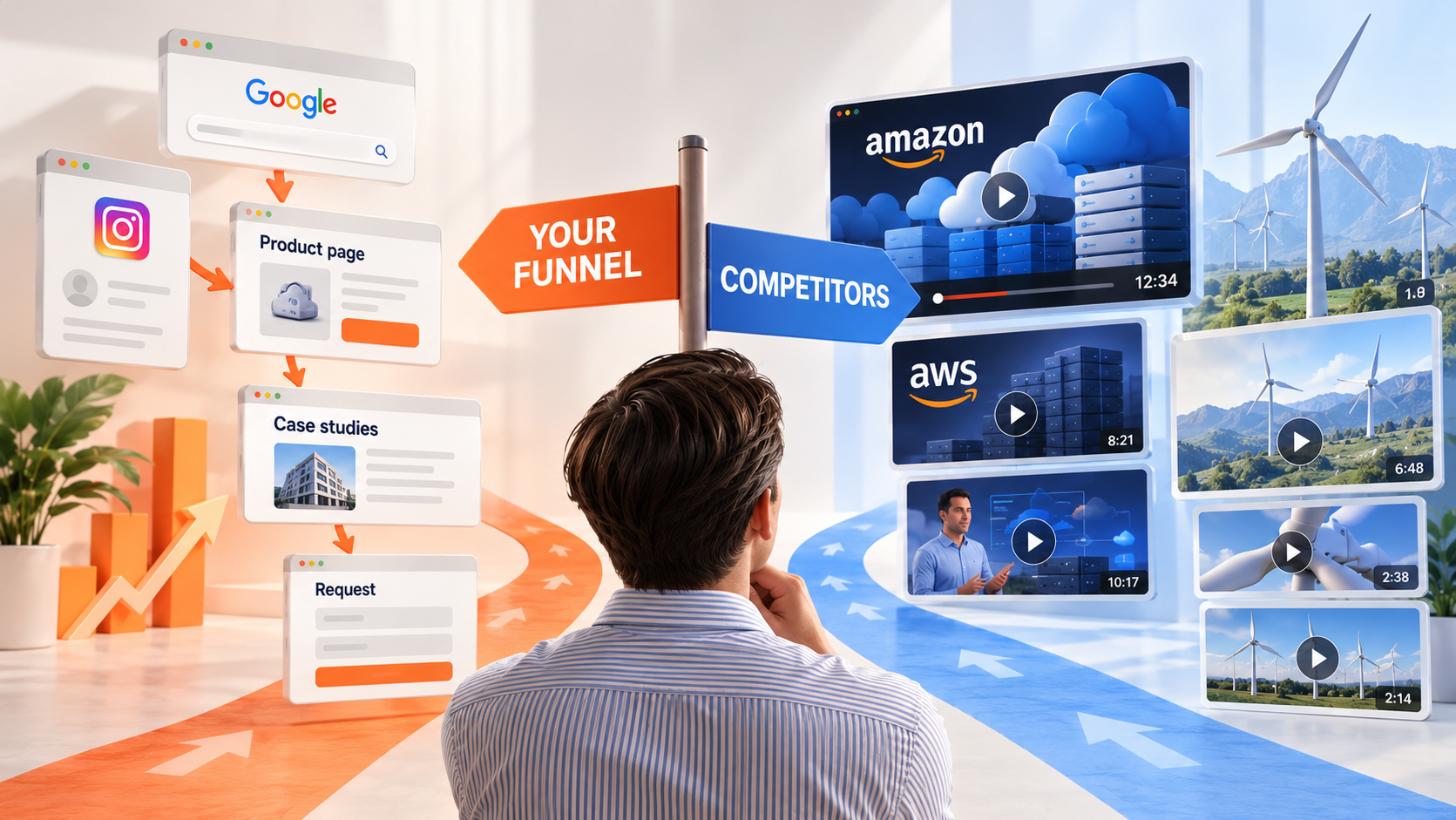
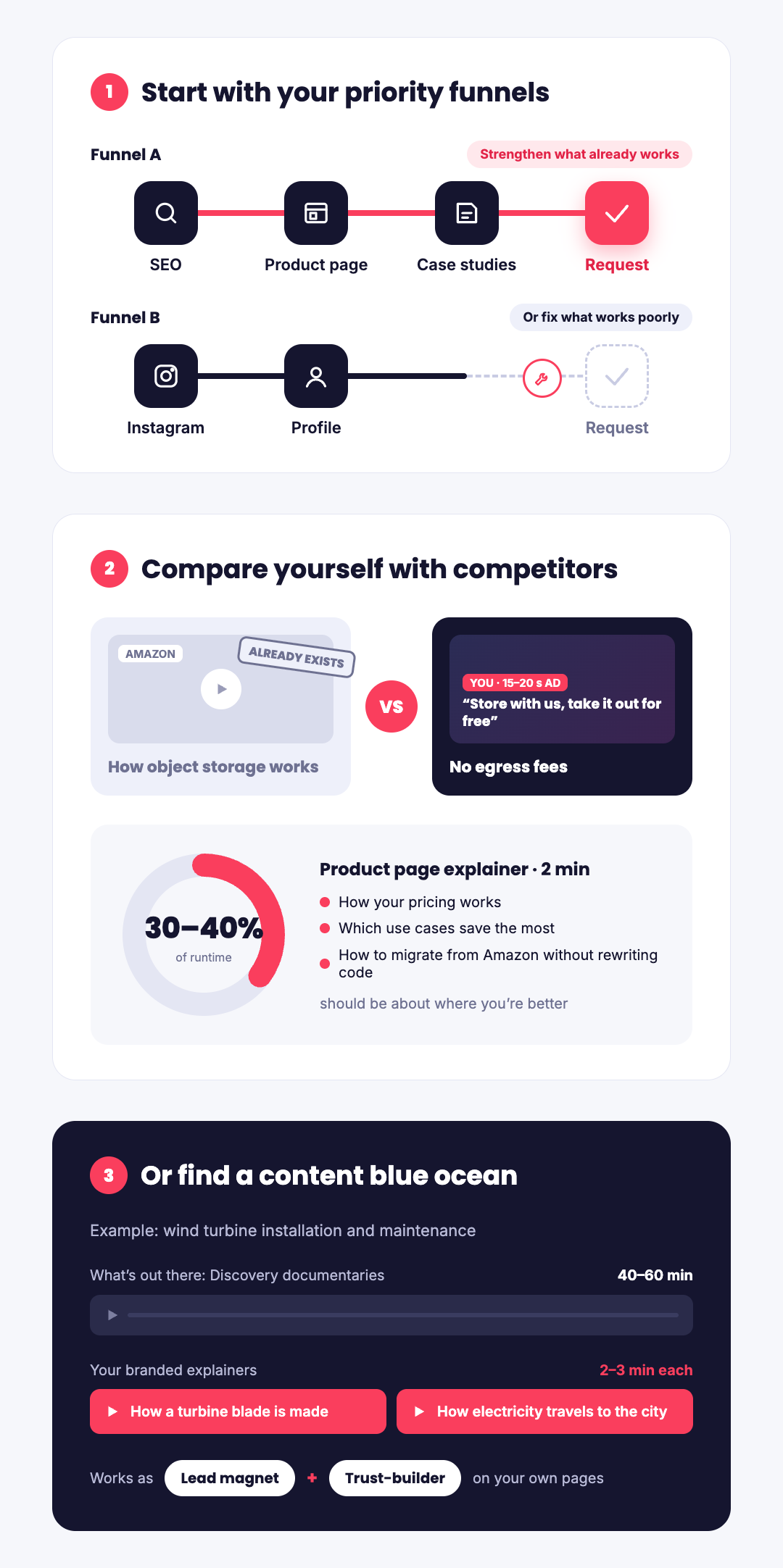
Start with your priority marketing funnels. You know how a client finds you, becomes a lead, and closes. Traffic from SEO to a product page to case studies to a request; or Instagram to profile to request. The logic is simple: strengthen what already works, or fix what works poorly.
The easiest way to decide is to compare yourself with competitors. Say you compete with Amazon in cloud storage. Amazon already made a big explainer about how object storage works — you don't need to remake it with your logo. You need an explainer that shows where you're better. For example, Amazon charges egress fees for outgoing data; say you don't. In a 15–20 second ad you focus on exactly that: "Store with us, take it out for free — no egress fees." On the product page you open it into two minutes: how your pricing works, which use cases save the most, how to migrate from Amazon without rewriting code if you're S3-compatible. Roughly 30–40% of the runtime should be about where you're better.
The opposite case — when it makes sense to copy Amazon's "hundreds of explainers" approach — is when you're in a content blue ocean. If you install and maintain wind turbines and the only videos out there are 40–60 minute Discovery documentaries, short two-to-three-minute branded explainers (how a turbine blade is made, how electricity travels to the city) work as both a lead magnet and a trust-builder on your own pages.
For a SaaS explainer used as a 30–60 second targeting ad, look at competitors again. If a rival works the same niche with the same audience and similar selling points, you need more complex visuals just to look different.
Simple 2D looks like Google Vids: clean typography, interface elements, smooth motion design.
Complex 2D looks like an ERP ad — characters, lots of motion, varied illustrations, close-ups.
In 3D, Lexis+AI is a stylish half-2D/half-3D piece;
Rivet is a clear level above, with the interface living inside an abstract, bright 3D space.
What separates simple from complex? Two things: a more considered style and design (an experienced creative director and art director), and the number of distinct elements (more illustrators and 3D artists, more time).
My price estimates for the four:
One of our own SaaS explainers cost about $12,000 — almost the same as Rivet. Over 90% of landing-page viewers watched it to the end, and over 65% of the creators we reached out to signed up.
Case study: SaaS explainer — the $12,020 line-by-line budget, from art direction to the voice actor.
With AI you can reproduce the style of 2D, 3D or live action. So AI isn't a type of visual — it's a technology for creating visuals. First decide live action, 2D or 3D; then use AI as a tool to produce what you already chose.
In one of our projects, AI characters sit next to a 3D space in the same video. One detail I love: the AI actress's finger didn't match the phone screen we needed to add later, so we regenerated the shot until she tapped exactly the bottom of the screen — and we never asked AI to draw the interface inside the phone, which would have meant endless errors. And remember that $2,500 from the start? For that client we offered two options: about $2,500 with adapted graphic templates, or about $6,000 with fully custom graphics.
Case study: AI video production & 3D motion graphics.
If you have a physical product or a physical process, live action is usually the best choice — sometimes combined with 3D. To show how car frames are made, bring a host to the factory and walk through the process step by step. The Amazon logic still applies: if a competitor already explained how their factory works, show where you're better — more modern robots, more automated processes, better quality control, fewer defects.
How is this different from a corporate video? A corporate film covers the whole factory in about five minutes so a visitor understands "this is a serious operation." An explainer covers one part — a two-to-three-minute piece on quality control, for instance. And 3D/2D illustrate what you can't film (the clean cross-section of a road that doesn't exist in reality) or the full picture (a top-down 3D view of the whole production line) — adding to the live action, not replacing it.
So the $30,000 explainer: a shoot at a factory with a host explaining the process, plus 3D for the parts you can't film, plus 2D to show the whole factory at once. Three productions in one video — a film crew, a 3D team and a 2D team. That's why it costs around $30,000, almost three times more than Rivet.
Even a two-minute explainer can work as an ad. Look at Salesforce's partnership with Anthropic — "Claudeforce," a two-minute video with Matthew McConaughey.
At its core it's a classic explainer showing how AI works inside your CRM. As a plain ad, fifteen seconds would do: "AI is already in your CRM," then the logo. But here the goal is to educate — why AI helps sales and where it fits — and the actor, delivery and edit let it sit in two categories at once: explainer and ad.
So: what process in your business do clients not understand the first time? If you want help picking the right format for your budget, reach out to us at Lava Media — we'll help you choose.