Distribution
Viewability, Ad Recall and View-Through Rate: What Your Video Ad Numbers Really Mean
What viewability, view-through rate and ad recall really measure, and what moved them in our Meizu CTV campaign.

Sergey
November 4, 2026

What viewability, view-through rate and ad recall really measure, and what moved them in our Meizu CTV campaign.

A million impressions can mean a million people saw your ad. It can also mean the player loaded below the fold, muted, while everyone scrolled past. Views alone don’t tell you which one you paid for.
Three metrics do a better job. Viewability tells you whether the ad had a chance to be seen. View-through rate tells you whether people kept watching. Ad recall tells you whether anyone remembers it a day later.
We’ll walk through each one: what it measures, how platforms count it, and what moved it in a real campaign. The campaign is a 15-second spot we made and placed for Meizu, described in full in our Meizu CTV brand lift case study. Per our campaign reporting, it reached 88% viewability, a 78% completion rate in online video and a +26% lift in ad recall.
Each metric answers one question, and each one is measured by a different kind of tool. Mixing them up is how campaign reports end up looking great and proving nothing.
The first two come from the ad server automatically. The last two need a survey, which is why many campaigns never measure them.
Viewability is the share of your ad impressions that actually had a chance to be seen. An impression is counted the moment the ad is served. Whether a person could see it is a separate question.
The industry standard comes from the Media Rating Council (MRC), developed with the IAB. A video ad counts as viewable when at least 50% of its pixels are on screen for at least 2 continuous seconds. For display banners the bar is 50% for 1 second. The MRC cleared the standard for buying and selling on June 30, 2014 (MarTech, MediaPost). Those 2 seconds don’t have to be the first 2 seconds of the ad.
Two things follow from that definition:
For reference, Integral Ad Science’s Media Quality Report for 2025 data puts global video viewability at 79.7% and display at 67.9% (Digital Applied, MediaNews4U).
Connected TV sits higher. Ads play full screen, one at a time, between episodes on a living-room screen. IAS reported 93.3% CTV viewability for the second half of 2020 (IAS). CTV is measured with different signals than a web page, though, and the MRC only accredited the first CTV viewability measurement, from IAS, in May 2023 (IAS). Treat a CTV figure as its own benchmark rather than comparing it line by line with mobile web.
We didn’t raise the number with a better edit. Almost all of it came from media decisions made before launch:
The result, per our campaign reporting with IAS tracking, was 88% viewability.
View-through rate (VTR) is the share of people who kept watching your video ad after it started. That much everyone agrees on. The exact formula depends on the platform, which is why two reports on the same campaign can show wildly different numbers and both be right.
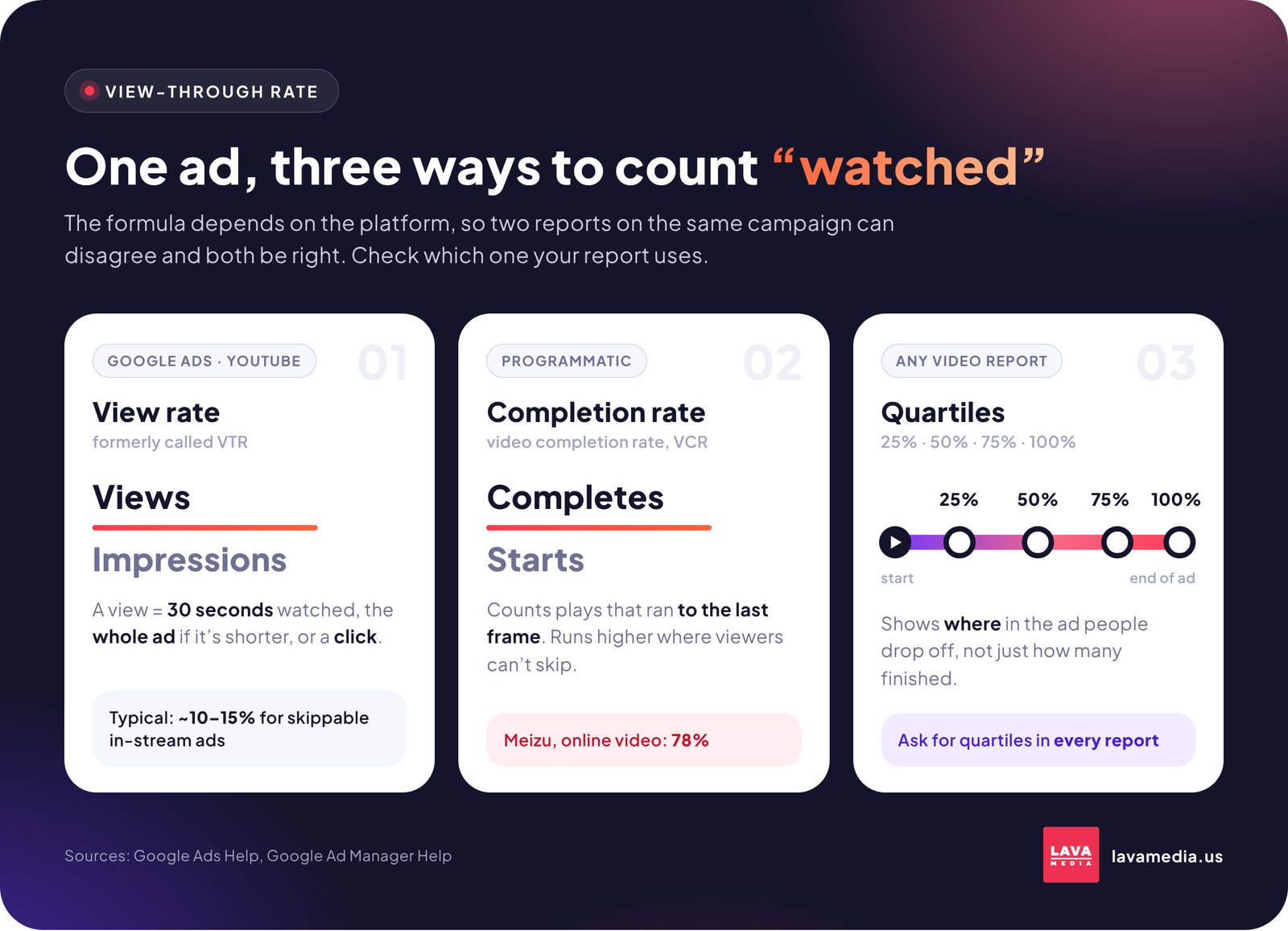
Sources: Google Ads Help, Google Ad Manager Help.
Google notes that a view rate of around 10–15% is typical for skippable in-stream ads. A completion rate on inventory people can’t skip naturally runs higher. Neither number is wrong. They just measure different things, so always ask which formula a report used.
For Meizu, our reporting showed a 78% completion rate for online video: 78% of online video plays ran to the end.
Two creative decisions move completion more than anything else: how long the ad is and what happens before the viewer decides to stay.
On length, we looked at the data in a separate breakdown, How Long Should Your Commercial or Business Video Be?. On TV, 30-second spots showed the highest completion rate in the reports we reviewed. Fifteen seconds works best as a reminder for people who have already seen the longer cut.
The Meizu spot was 15 seconds and ran inside a long-running brand campaign, not as a first introduction. With 15 seconds, the hook has to land immediately. We built the spot on a famous painting of three knights on horseback that the local audience knows by heart, so the setup needed no explanation. Then two twists: the knights aren’t scanning for enemies, they’re admiring the view, and the youngest one pulls out a smartphone to film it.
A familiar image buys you the first two seconds. A broken expectation buys you the rest.
The two sound alike but measure different memories (SurveyMonkey, Qualtrics):
Both come in two strengths. Unaided recall means the person names the brand with no hint. Aided recall means they recognize it from a list or a prompt. Unaided is the harder test and the more valuable result.
Ad recall on its own is just a percentage of people who say they remember the ad. Some will “remember” it even if they never saw it. That’s why serious studies report ad recall lift: the same survey is shown to people who saw the ad and to a control group who didn’t, and the difference between the two is the effect of the ad.
Google’s Brand Lift works this way on YouTube: short surveys go to people who saw your ads and to people who were eligible but weren’t shown them, and it reports lift in ad recall, awareness, consideration and other brand metrics (Google Ads Help). Independent research panels run the same exposed-versus-control logic across channels.
One thing to check in every lift report: is the lift absolute or relative? If 20% of the control group remembers the ad and 25% of the exposed group does, that’s a 5-point absolute lift, or a 25% relative lift. Same campaign, very different-looking number.
Per our campaign reporting (surveys embedded in YouTube, Nielsen research panels and IAS tracking), the Meizu spot delivered:
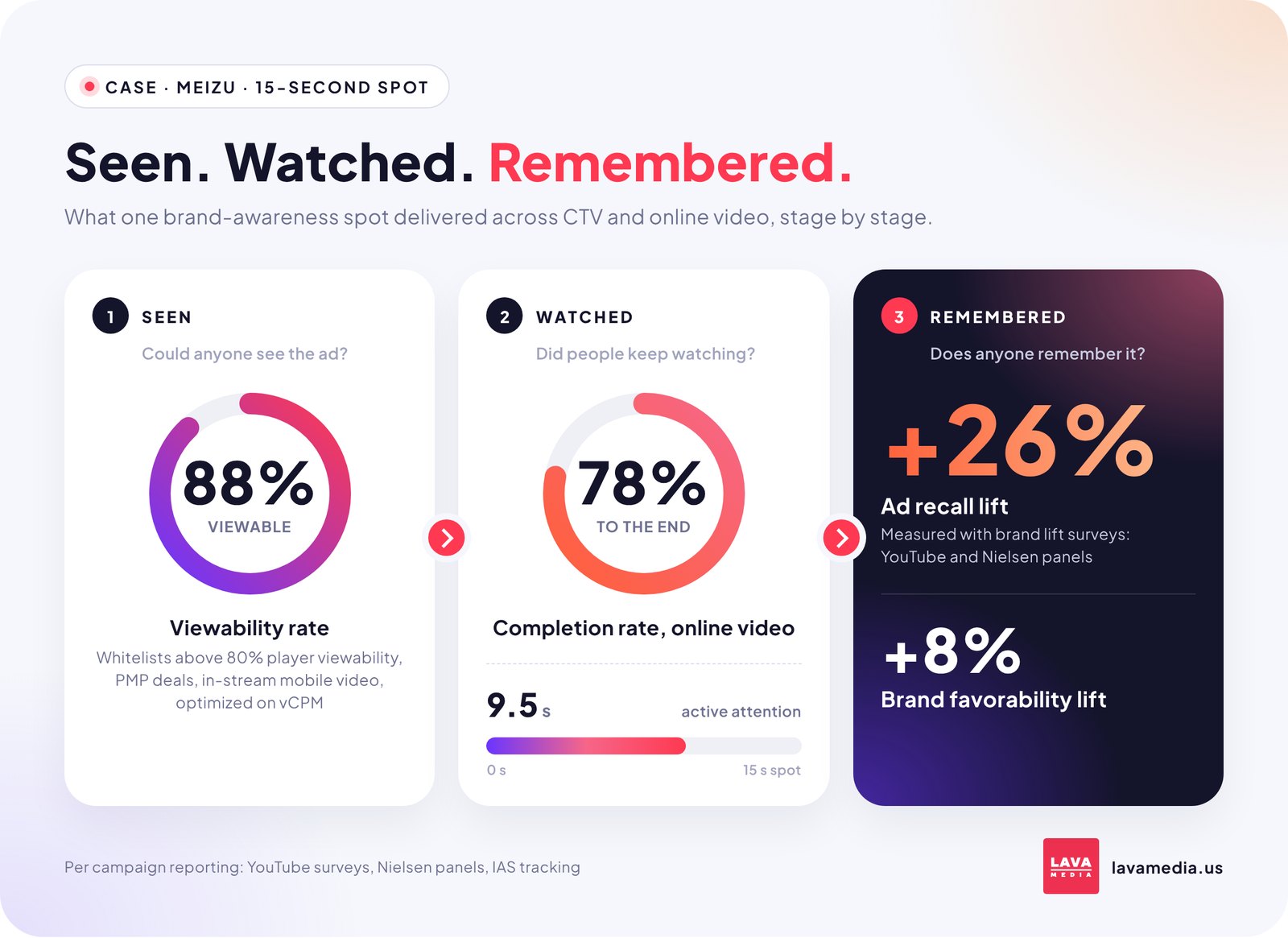
The recall result is the one we’d point to. The creative was built to be remembered, and the media plan made sure people actually saw it.
One spot can lift ad recall within a campaign. Brand recall comes from showing up consistently, and the 15-second knights spot was one piece of a much longer story.
We worked as Meizu’s advertising agency for five years, starting in 2014, when the brand was entering a market dominated by much bigger players. Early on, we made bright animated spots for cinema screenings whose main job was brand recall. Later came a football team sponsorship, player commercials and a YouTube channel for football fans, which together raised brand awareness among football viewers by 14.5% in a single year. Over the partnership, Meizu’s smartphone market share in the target region grew from zero to 4%. The full story is in our Meizu brand launch case study.
If you’re paying for video distribution, these questions turn a report full of big numbers into one you can act on:
An agency that plans media around these numbers should be able to answer all eight.
What is a good viewability rate for video ads?
IAS puts the global average for video at 79.7% for 2025. CTV usually runs higher. Anything well below the average usually points to placement, not creative. For Meizu, whitelists and in-stream placements got us to 88%.
What is a good view-through rate?
It depends on the formula. For skippable YouTube in-stream ads, Google calls a view rate of about 10–15% typical. Completion rates on inventory people can’t skip are much higher. Compare the same metric, on the same platform, for the same ad length.
What is the difference between viewability and view-through rate?
Viewability tells you the ad was on screen long enough to be seen: 2 seconds at half size. View-through rate tells you people chose to keep watching. An ad can be 100% viewable and still be skipped.
Is ad recall the same as brand recall?
No. Ad recall is about remembering a specific ad and is measured shortly after people see it. Brand recall is about remembering the brand and builds up across many campaigns.
How is ad recall measured?
With a survey shown to people who saw the ad and to a control group who didn’t. The difference between the two groups is the ad recall lift.
Are CTV ads 100% viewable?
Not automatically. CTV ads play full screen, so viewability is high, and IAS once reported 93.3%. But CTV is measured differently from the web, so ask for a verified figure instead of assuming one.
Viewability is won in the media plan. Completion is won in the first seconds of the edit. Recall needs both.
At Lava Media, we plan the creative and the placement together, then report on viewability, completion and brand lift rather than on how many people liked the finished film. See how we do it on our digital marketing video production page, or request a quote for your next campaign.