
2D
Explainer Video Cost Per Minute: What One Minute Really Costs
Real budgets from six of our explainer projects: what one minute of AI, 3D, 2D and live action actually costs.

Sergey
November 3, 2026
If you came here for a number: across our recent explainer projects, one finished minute has cost anywhere from about $2,500 to about $17,700. AI-generated films sit at the bottom of that range, 3D product and industrial explainers in the middle, custom 2D animation and live action with CG at the top.
But “per minute” is a convenient unit, not an honest one. When a client asks me what a minute costs, I don’t quote a rate. I show three or four of our videos and say: this one cost this much per minute, this one that much. Then we talk about what you actually need to say, and in which format. Here’s why, with real budgets from our projects.
Every number below is a real budget for a finished video. The per-minute figure is simply the budget divided by the runtime.
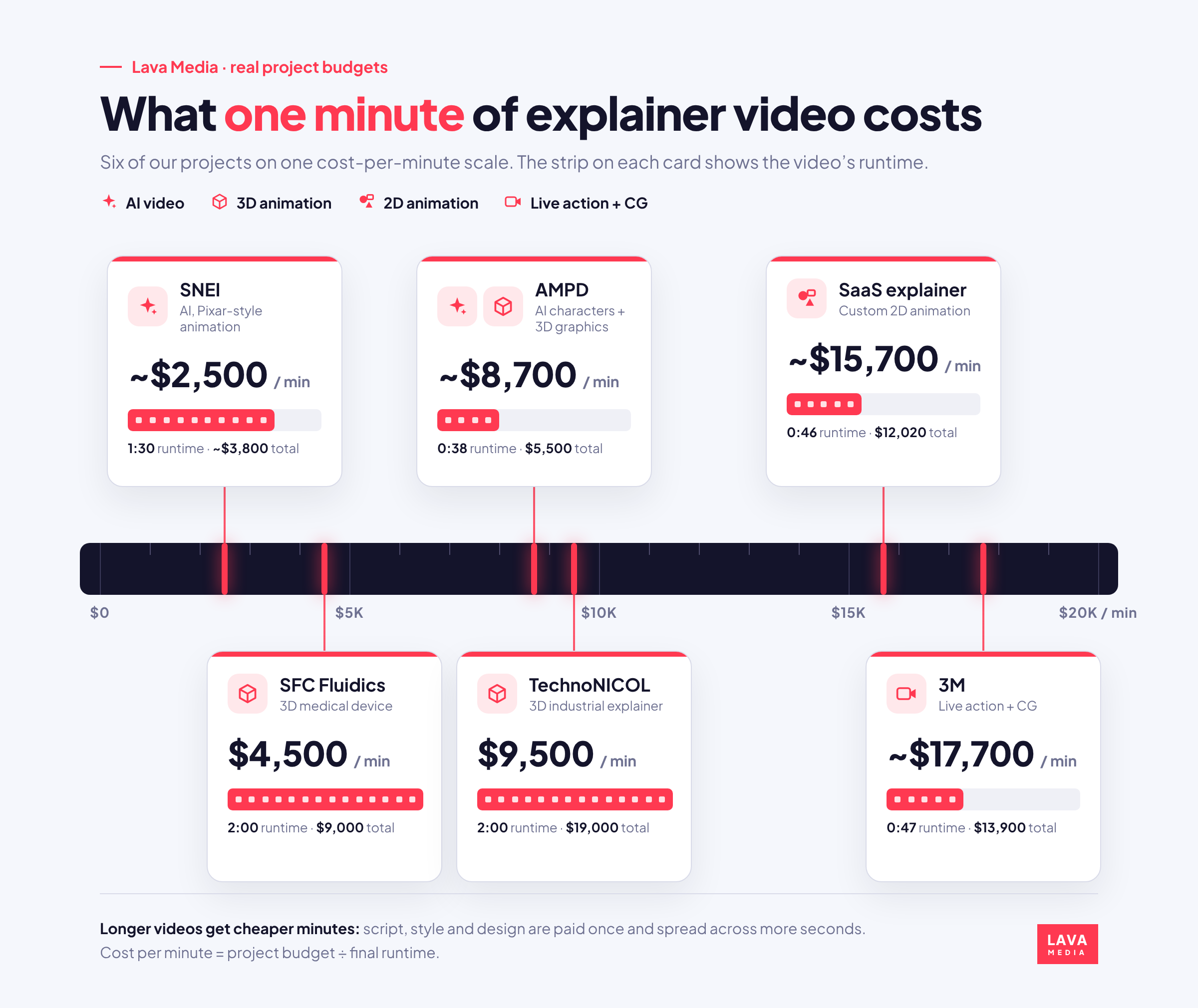
Look at the order. The two-minute 3D videos are cheaper per minute than a 46-second 2D explainer. That’s not because 3D is cheap. It’s because a long video spreads its fixed costs over more seconds, and because in 3D a lot of the work can be reused. Both points are worth unpacking.
Every explainer budget has two parts: what you pay for once, and what you pay for every second.
Our SaaS explainer is a good example, because we published its full budget. Out of $12,020:
Half of that budget would have been spent whether the video ran 30 seconds or two minutes. Someone still has to write the script, find the visual style and draw the characters. That’s why the shortest videos have the most expensive minutes.
The other half doesn’t grow evenly either. What matters isn’t the extra seconds. It’s what has to be newly made for them.
So the honest answer to “how much does one more minute cost?” is: it depends on what happens in that minute.
AI brings the cost down for every type of video: 2D, 3D and live action. Any of them can be produced with generative tools, and that will be the cheapest way to make it. Our Pixar-style film for SNEI ran a minute and a half for about $3,800, roughly $2,500 per minute. Traditional 3D character animation at that level would need a full studio team.
What makes an AI video more expensive: more locations, more characters, avatars, and more requirements for each scene, such as how the camera moves and where characters walk. The more you ask of the model, the more you experiment, and the more it costs.
What AI doesn’t do well is precision. Right now we’re producing a 2D explainer for a brand with a lot of elements and a lot of movement. A model would produce bugs and glitches in that kind of animation, and the brand needs a premium look without them. So we’re animating it by hand. The other question is perception: if AI replaces a real shoot, viewers can tell, and you have to decide whether that matters for your audience.
Our two-minute medical device animation for SFC Fluidics cost $9,000, or $4,500 per minute. The two-minute 3D explainer for TechnoNICOL, which shows insulation layers inside roads and subway tunnels, cost $19,000, or $9,500 per minute.
Both are long and both reuse their models from scene to scene, which is why their minutes are relatively cheap. That’s typical for 3D animation of a product or a process. The difference between them is mostly how much had to be built: one device versus whole environments.
For AMPD we combined AI-generated characters with custom 3D motion graphics in a 38-second spot. It cost $5,500, about $8,700 per minute. A short runtime with a fully custom graphic system is exactly where per-minute cost climbs.
Our SaaS launch explainer ran 46 seconds and cost $12,020, about $15,700 per minute. It had four locations, four characters, a stylized product interface and a new effect roughly every three seconds. Over 90% of landing-page viewers watched it to the end.
In 2D animation, the price per minute is set mostly by how many scenes you fit into each 30 seconds and how detailed they are. We break that down in our guide to 2D animation cost per minute.
For 3M we shot a real dentist in a rented apartment and tracked 3D graphics into the footage: 47 seconds for $13,900, about $17,700 per minute. In live action you mostly pay for crew, equipment, location and shooting time, then for the CG on top. That’s why live action is priced by shooting days and scenes rather than by minutes.
Bigger productions go further. Our training series for Accu-Chek, which combined a studio shoot with 2D animation of how an insulin pump works, cost $45,000 for the series.
Runtime should follow the task, not the budget. In our experience:
If you need both, plan them together. Build the long version first, then cut short versions from the same assets. You pay for the style, characters and models once.
A cheap minute from templates or a freelancer can be a perfectly good choice, if you know exactly what you need. (Template-based 2D starts at around $1,800 even with us, as we explain in our startup animation guide.) Usually that means someone on the client side has produced videos many times and can act as their own creative director and producer: write the brief, find the right freelancer and judge the result. In practice, that’s often a former video producer who moved in-house.
If nobody on your team plays that role, the savings tend to disappear in rewrites and in a video that doesn’t do its job.
How much does a 1-minute explainer video cost?
In our projects, a finished minute has ranged from about $2,500 (AI animation) to about $17,700 (live action with CG). Custom 2D animation sat around $15,700 per minute for a 46-second video.
Is 3D more expensive per minute than 2D?
Not necessarily. Once a 3D model is built, extra seconds that reuse it are cheap. Our two-minute 3D explainers cost $4,500–$9,500 per minute, less than a short custom 2D video.
Does a 2-minute explainer cost twice as much as a 1-minute one?
Rarely. Script, style and character or model design are paid once. Whether the rest doubles depends on how many new scenes, elements or shooting hours the second minute needs.
Does AI make explainer videos cheaper?
Yes. AI lowers the cost of every format, and it’s usually the cheapest way to produce a video. It struggles with precise, element-heavy animation and can affect how viewers perceive a brand, so it isn’t always the right choice.
Why do agencies quote per project, not per minute?
Because the same minute can be one host speaking to camera or a new location with a new cast. The script decides the cost, not the clock.
Tell us what you need to explain and where the video will run, and we’ll show you comparable projects with their real per-minute cost. See our animated explainer video services or request a quote.


